
Blog, Strategies
October 12, 2026
Generational Trends: A Playbook for Financial Institutions
How banks and credit unions can make digital experiences more relevant at every life stage The tradi...
Digital banking solutions have transitioned from a secondary touchpoint to the primary way consumers manage their financial lives. The 2026 Digital Banking Performance Metrics Report, commissioned by Alkami Technology and authored by Cornerstone Advisors (Cornerstone), reveals that success for regional and community financial institutions (RCFIs) is determined by how wisely they measure performance of digital solutions, how effectively they drive adoption, and continued usage of the technology they invest in.
In this seventh edition of the benchmarking report, the retail banking data highlights a clear divergence between financial institutions that view digital as a cost center and those that use it as a growth engine. Indicators are broadly encouraging:
“Before declaring victory on efficiency, it’s worth asking what the trade-off has been. A platform that costs less per user and requires fewer staff to manage is only a success story if the user experience hasn’t quietly degraded in the process.” – Cornerstone’s Take (Page 3)
Research into the preferences of cross-generational account holders explains why this matters greatly:
Proving that RCFIs must move beyond basic transaction-based relationships to offering a compelling digital banking platform that encourages account holders to stay active and engaged.
Digital engagement among retail banking solutions users is reaching new heights, with average active users as a percentage of checking accounts rising to 87% in 2025 (+10% in just two years). Mobile banking has officially cemented its place as the primary channel, as activation rates jumped from a three-year plateau of 73% to a significant 82% this past year. How does an average of 17 monthly digital log-ins compare to your in-branch visits or call-center volume by account holder?
Digital banking users are adding more new products compared to the household average, engaging more frequently with their institution on average, and account for more than half of all loan applications.
Features like chatbots, bill pay, mobile payments—when users make transactions using their mobile phones through applications (apps) that are linking their bank accounts, debit/credit cards, or digital wallets—and digitally opened checking accounts are also all on the up year-over-year. eStatement recipients climbed to 79% of active digital banking users, with 80% opting out of paper statements entirely. These upward trends illustrate that the digital banking platform is where account holders “live” financially.
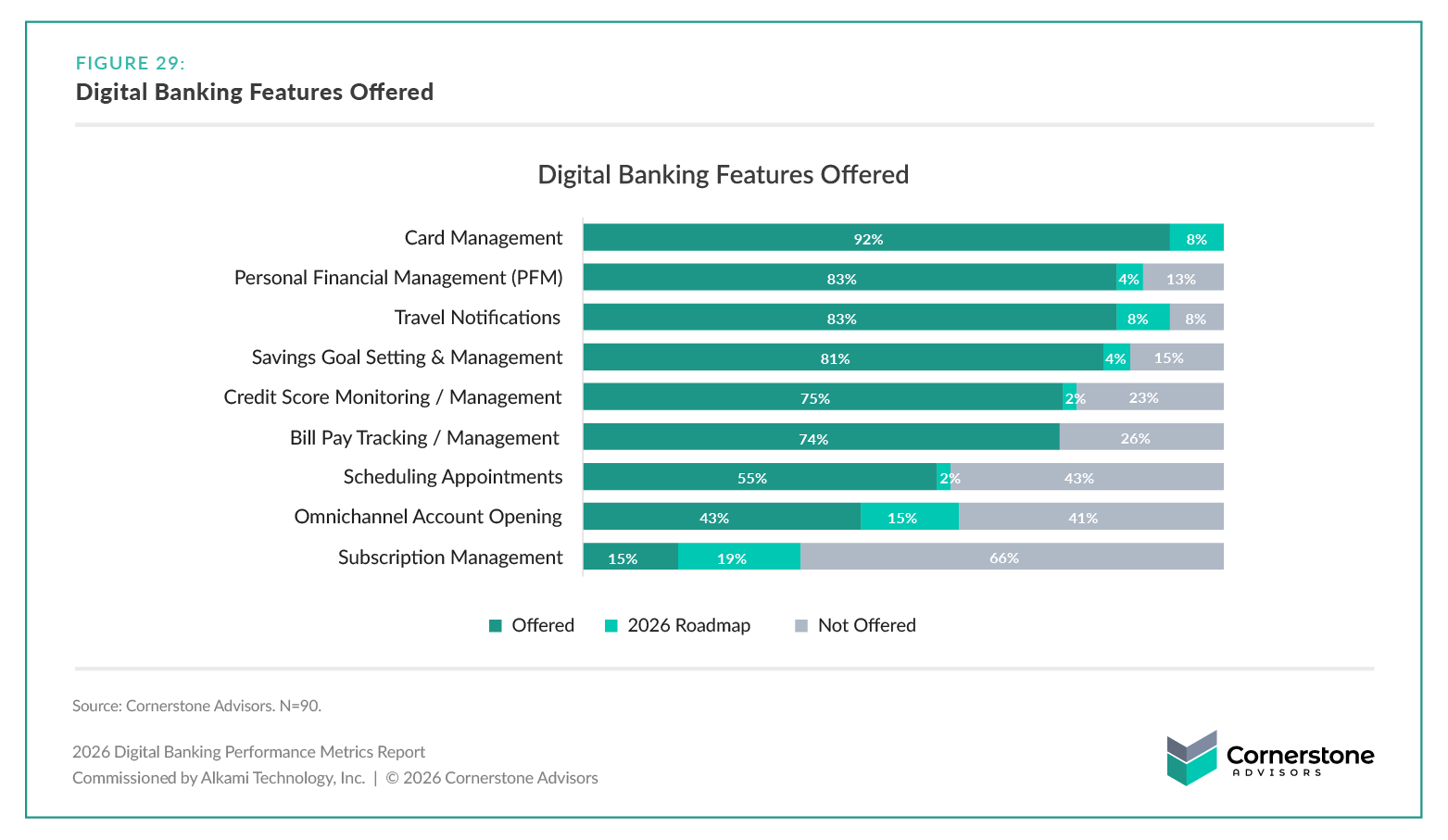
For financial institutions, understanding these and other digital banking performance metrics represents a massive opportunity to leverage this vehicle for retention and acquisition. Ask the hard questions from your team—where is there an opportunity to drive more adoption? How can we remove friction from the process and keep consumers engaged in the experience?
The 2026 Digital Banking Performance Metrics report finds that digital account opening is gaining momentum, but significant execution gaps remain. Digital checking account openings rose to 27% of all openings in 2025, up from 21% the previous year. However, abandonment remains a critical challenge, with an average of 3.36 applications abandoned for every one account successfully opened. A significant gap of nearly 9,000 potential new accounts unrealized.
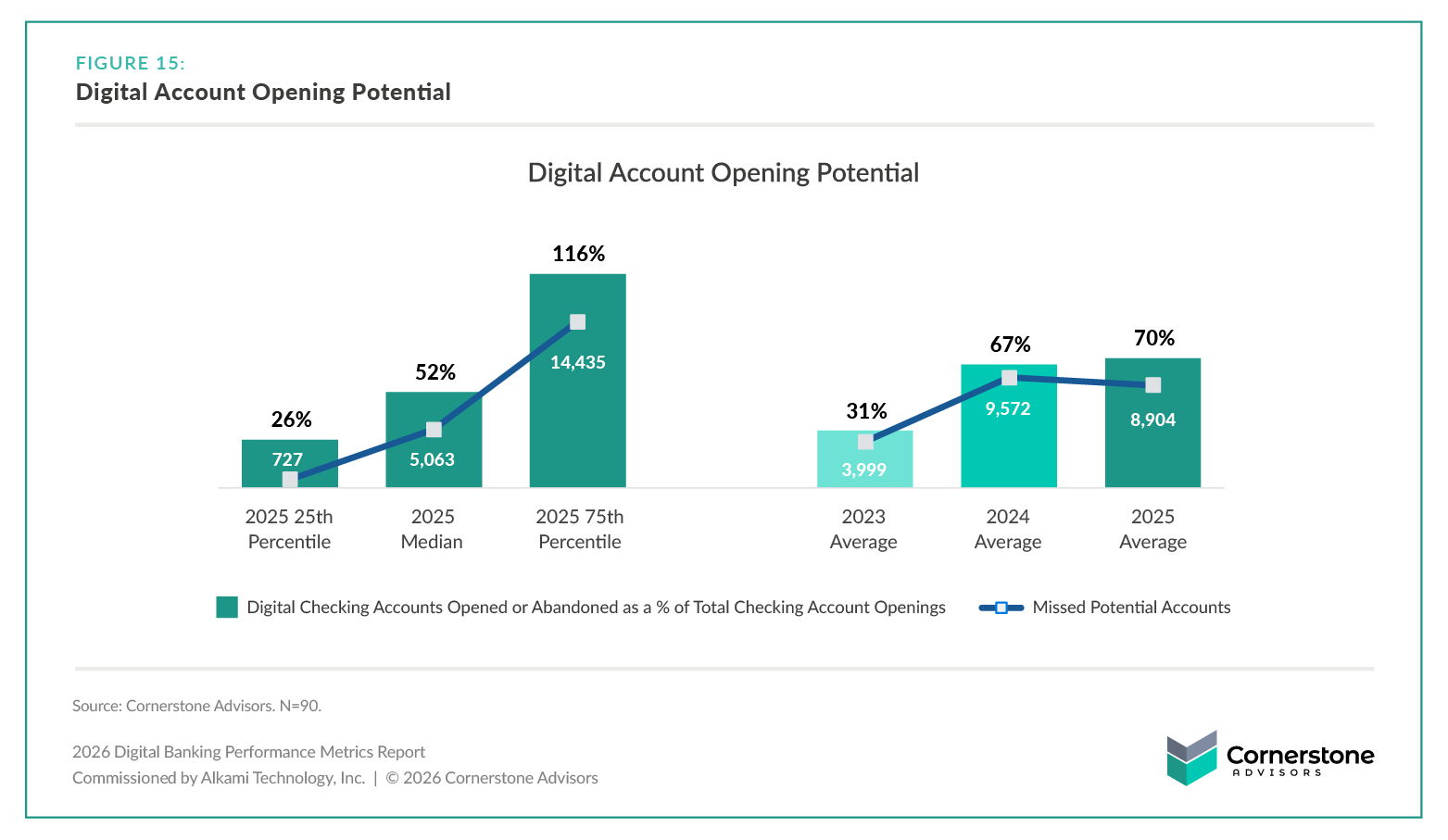
An assertion that Cornerstone makes within this report is that digital account opening abandonment rates are most often a product of two factors: processing speed and user experience (UX) design. Explaining that friction at the point of application most often stems from identity verification hurdles requiring consumers to switch devices mid-flow to upload a document or call the branch. Institutions that successfully reduce this friction, even allowing applicants to return to an application mid-flow without having to start over, see the digital channel function as a funnel rather than a filter, capturing thousands of missed potential accounts.
For omnichannel account opening best practices, see our guide: Why Leading Financial Institutions Use One Platform to Open All Retail and Business Deposit Accounts
The digital channel is increasingly responsible for institutional growth, particularly in lending and relationship expansion. For the first time, Cornerstone found that digital consumer loan applications crossed the 50% threshold, hitting an average of 51% in 2025.
Furthermore, digital engagement is directly linked to product depth. On average, financial institutions expanded their relationship with digital users by 1.56 new products per user in 2025. This outpaced growth in the broader household base, suggesting that active digital banking users are the most embedded and valuable segment for a bank or credit union. This also proves that account holders are now comfortable managing complex financial needs entirely through digital interfaces.
Learn more about mastering cross-selling using artificial intelligence in banking.
The annual Digital Banking Performance Metrics reports are intended to give RCFI executives perspective. There’s no limit to what a financial institution could measure, especially as metrics should be tailored to an institution’s growth goals and strategy. However, the cost is in measuring the wrong things or measuring the right things without knowing how to turn those insights into action.
That’s what this report, and its metrics framework is for.
According to Cornerstone, financial institutions need a digital banking metrics framework that does three things:
The competitive pressure on both sides of this report is real and accelerating. Institutions that will win in the next decade aren’t necessarily the ones with the best efficiency ratio or spending the most on digital banking solutions, but they’re the ones measuring the right metrics and moving on what they find.
1What is the current percentage of active mobile banking users, according to the 2026 Digital Banking Performance Metrics study?
The percentage of active mobile banking users in 2025 increased to 82% moving past a previous three-year plateau of 73%.
2How much does a typical financial institution spend per digital banking user, according to the 2026 Digital Banking Performance Metrics study?
The average spend per digital banking user is $19, though performance metrics show that institutions in the 75th percentile spend as much as $26 per user, and those in the 25th percentile spend $12.
3Why is digital account opening abandonment such a concern, according to the 2026 Digital Banking Performance Metrics study?
For every one account successfully opened, an average of 3.36 applications are abandoned. This represents a significant execution gap and nearly 9,000 missed potential accounts for the average institution.
4Has digital banking consumer lending reached a tipping point, according to the 2026 Digital Banking Performance Metrics study?
Yes, for the first time, digital consumer loan applications have crossed the 50% threshold, hitting an average of 51% in 2025.
5What should a digital banking performance metrics framework focus on, according to the 2026 Digital Banking Performance Metrics study?
According to Cornerstone Advisors, an ideal digital banking performance metrics framework for banks and credit unions should be narrowly focused only on the metrics which directly affect achieving business outcomes, and ensure the investments they’re making in digital banking solutions are positively contributing to those results.