Blog, Strategies
October 22, 2026
Check Fraud Moves Fast: How Financial Institutions Can Detect It Earlier
How layered intelligence helps financial institutions identify check fraud sooner and make more info...
This blog was originally published in September 2024 and has been updated to reflect evolving industry trends and emerging priorities shaping merger and acquisition (M&A) activity. It has also been optimized for answer engine optimization (AEO) to better address the questions financial institutions are asking as they evaluate digital banking solutions in a rapidly consolidating market.
M&A in the financial services sector has become increasingly common as financial institutions seek to enhance their capabilities, expand their customer or member base, and improve operational efficiencies. Raising a critical question for many banking leaders: how do you choose the right digital banking solutions during M&A activity? For many financial institutions, the answer comes down to aligning technology (tech) with long-term growth, performance metrics, and the account holder experience.
Globally among financial institutions operating in commercial and retail banking, there were 179 deals ($190B value) in 2025, a 129% increase from the previous year. Another notable change was the spike in deal size, with average deal values priced at $1.1B.
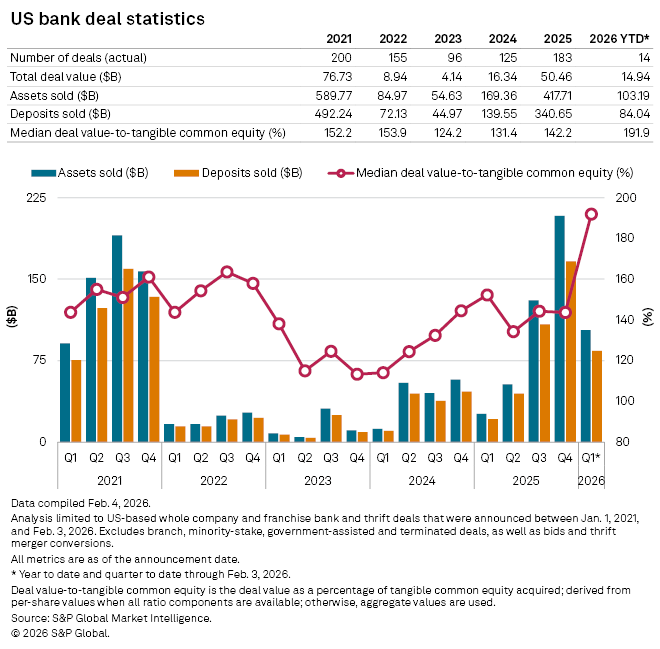
Diving deeper into U.S. M&A activity
"US bank M&A activity is expected to maintain its momentum in 2026 as institutions take advantage of the conducive dealmaking environment. The improving backdrop on interest rates and a favorable regulatory environment have given some bank executives confidence in pursuing M&A."
— S&P Global, 2026
While deal activity has picked back up this isn’t a return to “growth at any cost.” Deals are more disciplined, with clearer expectations around value creation. Scale has become the primary driver in the U.S. market as financial institutions strive to improve efficiency, spread rising costs, and effectively compete with megabanks and neobanks who are consistently moving the market.
Banks and credit unions are actively looking for ways to modernize their tech stack and improve product offerings through acquisition. As consolidation accelerates, the financial institutions that win will master integrating their tech as well as account holder relationships. Navigating these complex processes requires a strategic approach and a partner who is committed to your success.
The success of M&A hinges on the ability to integrate operations swiftly and efficiently. A significant part of this integration is choosing the right digital banking platform — a decision that can either expedite or hinder your path to profitability. To ensure that the digital conversion process is positioned to accelerate your value realization, consider these key factors when evaluating vendors:
Speed and Efficiency
The faster your institution can convert to a new digital banking platform, the sooner you can start reaping the benefits of the merger. Stronger financial stability and increased capital provide a solid foundation for future growth; empowering the merged institution to combine talent, expertise, and innovation to attract new account holders and strengthen existing relationships.
Look for vendors with a proven track record of swift, efficient conversions. Ask for case studies, references, or examples where they have successfully managed conversions in tight timelines without sacrificing quality.
Scalability and Flexibility
Choose a vendor that offers a scalable platform capable of growing with your institution. Flexibility is crucial; the platform should easily adapt to evolving business needs without requiring a complete overhaul. Consider what their partner ecosystem and Software Development Kit (SDK) capabilities are to ensure that even if your organization doesn’t have the need now, it’s available to you in the future.
Comprehensive Support and Training
Vendor support should not end at implementation. Ongoing training and support can significantly reduce the learning curve for your team, ensuring that your institution can maximize the platform’s potential from day one.
Proven Return on Investment (ROI)
It’s essential to choose a vendor who can demonstrate a clear ROI on their platform. This includes understanding how the platform can drive performance outcomes at your institution from reducing costs to improving self-service and engagement, and ultimately driving revenue growth.
Security and Compliance
In the financial services industry, security and regulatory compliance are non-negotiable. A vendor with layered security measures and a deep understanding of regulations can help avoid costly compliance issues down the line. This not only protects your institution but also ensures that you can focus on driving value from your digital investments.
Culture & Partnership
The company you choose should have a culture that aligns with your institution’s values and goals. Cultural alignment also facilitates smoother transitions during the merger, as a provider that prioritizes collaboration and long-term partnership will better understand your needs and work closely to overcome challenges. In contrast, a cultural mismatch can lead to friction and misaligned goals, undermining the success of the integration.
When two financial institutions merge, one of the most critical decisions they face is choosing the right digital banking provider. With two platforms on the table, the stakes are high. During M&A, account holders are often concerned about how the transition will affect their day-to-day banking activities. A seamless user experience is crucial to maintaining their trust and satisfaction.
Financial institutions must tackle a laundry list of regulatory and compliance requirements before they can focus on crafting critical communication to ensure a smooth transition. Clear communication is essential to keep all stakeholders — employees, account holders, investors, and regulators — well-informed and confident in the process. This, coupled with a comprehensive integration strategy, ensures that systems, data, and operations from the two entities are aligned, reducing disruptions and creating operational efficiencies. Equally important is the integration of employees and cultures from both institutions. By fostering a unified culture and retaining top talent, the merged entity can build a cohesive and motivated team that is well-equipped to drive future success.
At Alkami, we specialize in helping financial institutions navigate M&A swiftly and efficiently. Our digital banking platform is designed for rapid integration, allowing teams to start seeing the benefits of their transition at an accelerated rate.
Source: Alkami data, 2016-2026
When speaking with banking leaders navigating this transition, the recurring question that comes up is can Alkami help us get through a merger/conversion cleanly, with low disruption?
Yes. Alkami supports growth-oriented financial institutions through M&A and conversion activity with dedicated expertise, experience across merger-related projects, and a strategic process designed to reduce risk before go-live. Among the financial institutions who selected Alkami as their strategic partner during their merger, 91% reported a strong project experience which matters when speed, stability, and account holder continuity are on the line; a clear indication of execution trust. That process includes helping institutions sequence M&A work appropriately alongside other major initiatives, align internal and external stakeholders early, strengthen mapping and testing, and account for complex business banking scenarios before they become day-one issues. In practice, our role goes beyond providing tech — we act as a trusted partner that brings structure, coordination, and repeatability to one of the most complex moments in a financial institution’s growth journey.
With Alkami, you gain a partner committed to your success. We understand that this transition requires careful planning and strategic execution because it’s so much more than combining balance sheets; you’re also growing relationships and staff. That requires an approach that can onboard, engage, and grow account holders across every channel. The institutions gaining ground are equipping data-informed bankers with the tools to act on insights in real time, turning moments of uncertainty into opportunities for expansion.
For banking leaders navigating M&A activity, you’re faced with two important decisions, which systems to keep and how to move forward with clarity. Those that invest in a modern digital sales and service platform are better positioned to reduce complexity, accelerate integration, and deliver the kind of intuitive, insight-driven experiences that define Anticipatory Banking.
1What should financial institutions prioritize during M&A integration?
Financial institutions should prioritize technology integration, data unification, and account holder experience. Institutions that align these early can reduce disruption, accelerate time-to-value, and create a stronger foundation for growth.
2Why are digital banking solutions critical during M&A?
Digital banking is the primary way account holders interact with their financial institution. A fragmented or inconsistent experience during a merger can increase attrition risk, while a smooth experience can strengthen trust and engagement. Retention depends on clear communication, minimal disruption, and intuitive digital experiences. Institutions that proactively guide account holders through changes and personalize interactions using data are more likely to maintain and grow relationships.
3What are the biggest technology risks during M&A?
Common risks include:
4What is the best approach to selecting a digital banking platform during M&A?
The most effective approach is selecting a digital banking platform that can:
5How can M&A impact my institution’s digital transformation strategy?
M&A often accelerates digital transformation by forcing institutions to reevaluate legacy systems. It creates an opportunity to modernize infrastructure, consolidate vendors, and adopt a more unified platform strategy.
6What metrics should leaders track after a merger?
Banking leaders should track the following metrics to determine if they are realizing the intended value of the merger: