Blog, Strategies
October 15, 2026
Proactive Fraud Prevention in Digital Banking Solutions
Fraud prevention starts before the transaction October is Cybersecurity Awareness Month and we’re co...
The artificial intelligence (AI) conversation in financial services has been loud. Productivity. Automation. Virtual assistant. Co-pilots. Efficiency. Oftentimes, the focus has been on what capabilities the financial institution is equipped with versus shedding light on the needs of the consumer.
Your account holders may already be getting financial advice from AI. Asking how to save more, avoid fees, improve credit scores, compare products, and decide where to move money next. In many of those moments, they may not be asking their financial institution first.
That was at the center of this eye-opening conversation at Alkami Co:lab. Industry experts Theo Lau, Tiffani Montez, Jennifer White, and Jim Perry explored a fast-emerging reality for financial institutions: AI is changing how account holders search, compare, decide, and act. For regional and community financial institutions, this creates a new mandate: show up earlier, with better context, in the moments that matter most.
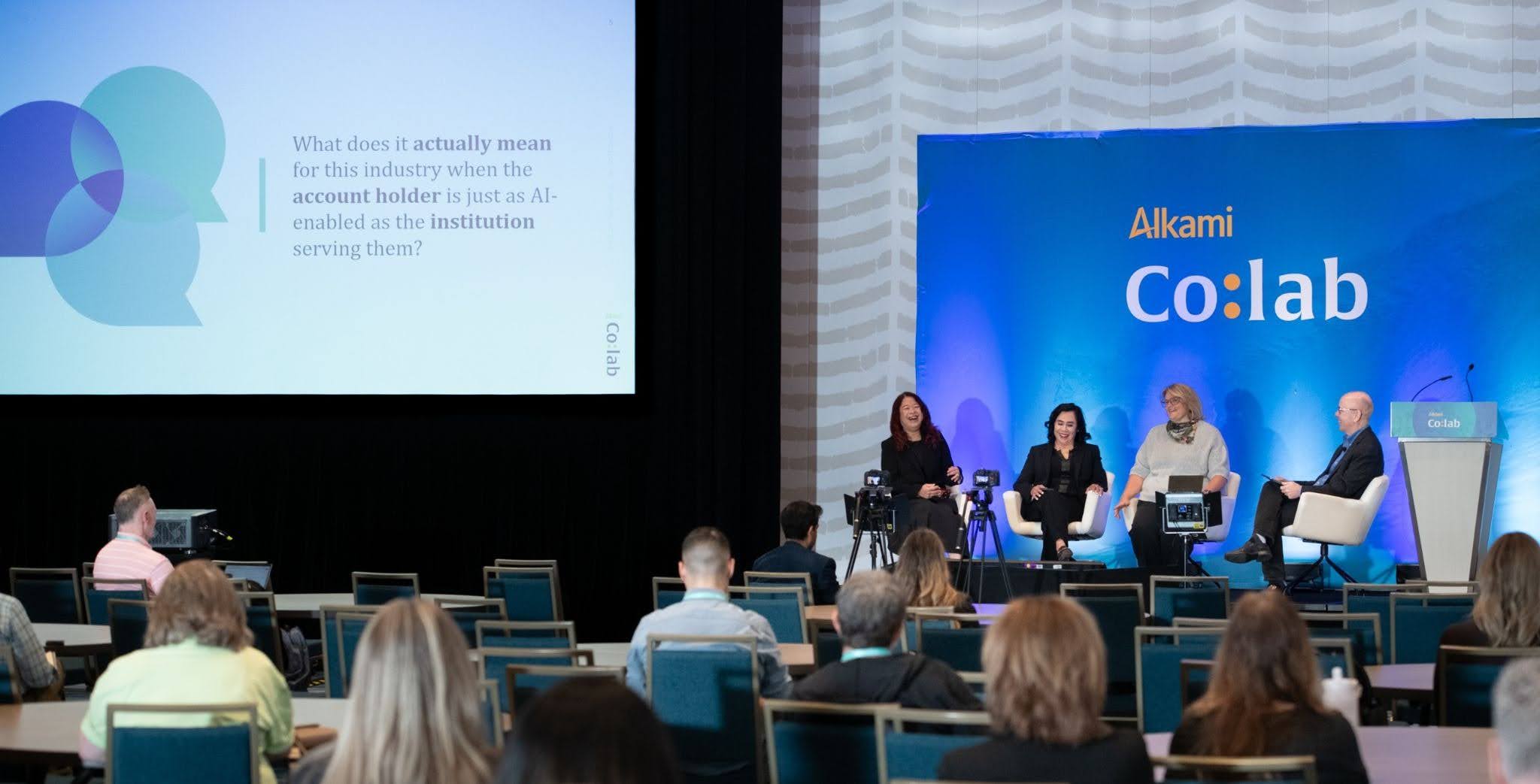
Watch this exclusive conversation
Account holders are increasingly using AI tools to research financial products, compare options, and find advice. Can AI find your financial institution?
Jim Perry challenged financial institutions to ask AI tools for information about their own products by only referencing the institution’s website. If the answer is incomplete, inaccurate, or missing, that financial institution may be invisible in a growing discovery channel.
Tiffani Montez added that a small set of financial brands are already dominating AI-generated mentions across financial categories. For regional and community financial institutions, this creates a real consideration risk: account holders may never evaluate your products if AI-powered discovery does not surface them.
Action for financial institutions
Audit your AI visibility. Search for your own products, rates, account
features, and service areas using AI tools. Then ask:
Your website, product pages, FAQs, local content, and educational resources all need to be clear enough for people and AI systems to understand.
Jennifer White shared one of the most important data points from the session: 53% of consumers used AI to ask for financial advice in the last three months. Among consumers under 40, that number rises to 68%.
That changes the role of the financial institution. Account holders are using generative AI chatbots, like ChatGPT, for help with saving strategies, credit scores, credit cards, fee avoidance, and other real financial decisions. If they are not getting clear guidance from their financial institution, they will look elsewhere.
Action for financial institutions
Turn common account holder questions into helpful, findable content.
Build educational resources around the financial decisions people are already trying to make:
Then connect those resources to digital banking experiences, targeted campaigns, and service conversations. The goal is to be useful before account holders have to leave your ecosystem for answers.
Jennifer White also shared that 1 in 5 consumers moved money away from their primary financial institution to a secondary deposit institution in the last 90 days, and that the average consumer now has three deposit accounts.
The concept of primacy is being reimagined. New account openings may trigger signs of attrition, however, account holders may choose to keep their primary relationship while moving savings, deposits, or activity elsewhere for niche financial solutions – making primacy more fluid. Loyalty is no longer proven by account ownership alone. It is tested through everyday behavior.
Action for financial institutions
Watch for signals that primacy is weakening. Look for patterns in their
data such as:
Then act before the relationship is at risk. Use timely outreach, relevant offers, education, and digital prompts to help account holders make their next best move with your financial institution.
Theo Lau made a practical point: financial institutions cannot anticipate account holder needs if data is scattered across disconnected systems. When a consumer interacts with various solutions across onboarding, digital banking, marketing, support, and risk systems, it becomes much harder to deliver timely, relevant experiences if their data is not shared throughout the full account holder journey. Ultimately, this presents them as different profiles versus one single customer or member.
This is where The Digital Sales & Service Platform becomes operational. It connects the capabilities financial institutions need to bring Anticipatory Banking to life by identifying account holder signals, acting across channels, and moving from reactive service to timely, relevant engagement across the relationship lifecycle.
Action for financial institutions
Start by connecting data around high-value use cases. For example:
Do not start with “How do we introduce automation and AI?” Start with “Where do account holders need us to show up sooner?”
While every financial institution sits at varying levels of AI readiness and adoption, banking leaders must face the reality that their consumers are actively using AI-powered tools outside of the digital banking platform. This is where the right AI strategy becomes important. Because at the end of the day, visibility matters. The questions customers and members may be asking are likely related to financial education, but ultimately that requires cross-functional partnership and marketing support to ensure that your institution’s resources are showing up as relevant results from an answer engine optimization (AEO) and search engine optimization (SEO) perspective.
Account holders are searching differently, moving money, comparing experiences, and making decisions with new tools in hand.
Financial institutions can respond by focusing on four key moves:
Ready to turn connected data into action? See how Alkami’s Digital Sales & Service Platform empowers financial institutions to onboard, engage, and grow relationships in the era of Anticipatory Banking.
How is AI changing account holder behavior?
AI is changing how account holders search for financial information, compare providers, and make decisions. Instead of relying only on a financial institution’s website, mobile application, or branch staff, many account holders are asking AI tools for advice on savings, credit, fees, and financial planning. This creates a new visibility challenge for financial institutions.
What is the AI visibility gap for financial institutions?
The AI visibility gap is the risk that a financial institution does not appear in AI-generated answers when account holders search for financial products, services, or guidance. If an institution is not discoverable in these interactions, it may be left out of the account holder’s consideration set.
Why does connected data matter for AI in banking?
Connected data helps financial institutions understand account holder behavior across systems and channels. Without it, AI may lack the context needed to deliver relevant insights or anticipate needs. With connected data, financial institutions can identify signals, reduce friction, and act in real time.