Blog, Strategies
October 12, 2026
Generational Trends: A Playbook for Financial Institutions
How banks and credit unions can make digital experiences more relevant at every life stage The tradi...
For years, connecting financial data across applications (apps) and services relied on a workaround. It wasn’t perfect, but it worked — until it didn’t.
As digital banking has evolved, so too have expectations around security, reliability, and transparency. Today, open banking application programming interfaces (APIs) are driving a fundamental shift in how financial data is accessed and shared. Screen scraping once served as a functional bridge, but it has increasingly become a liability.
This transition is a transformation in trust, performance, and user experience.
Before APIs became widely available, screen scraping filled a critical gap in financial data access. The process worked by allowing third-party apps to log into a user’s online banking account using their credentials, then “scrape” the visible data from the interface.
Because this model relied on users sharing their online banking credentials with third-party apps, financial institutions had limited visibility into how credentials were stored, accessed, or reused after consent was granted. Over time, this created growing concerns around credential exposure, account security, and the inability to limit data access to only what was necessary.
At the time, it enabled the rise of fintech innovation such as budgeting tools, payment apps, and account aggregation services that consumers quickly embraced.
From a user perspective, the experience was straightforward: enter your banking username and password into a third-party app, and your financial data would appear.
From a financial institution’s perspective, however, the process was far less controlled.
Despite its limitations, screen scraping served the industry “well enough” in its early stages. It unlocked connectivity in an ecosystem that lacked standardized data-sharing infrastructure. But as adoption scaled, so did the risks.
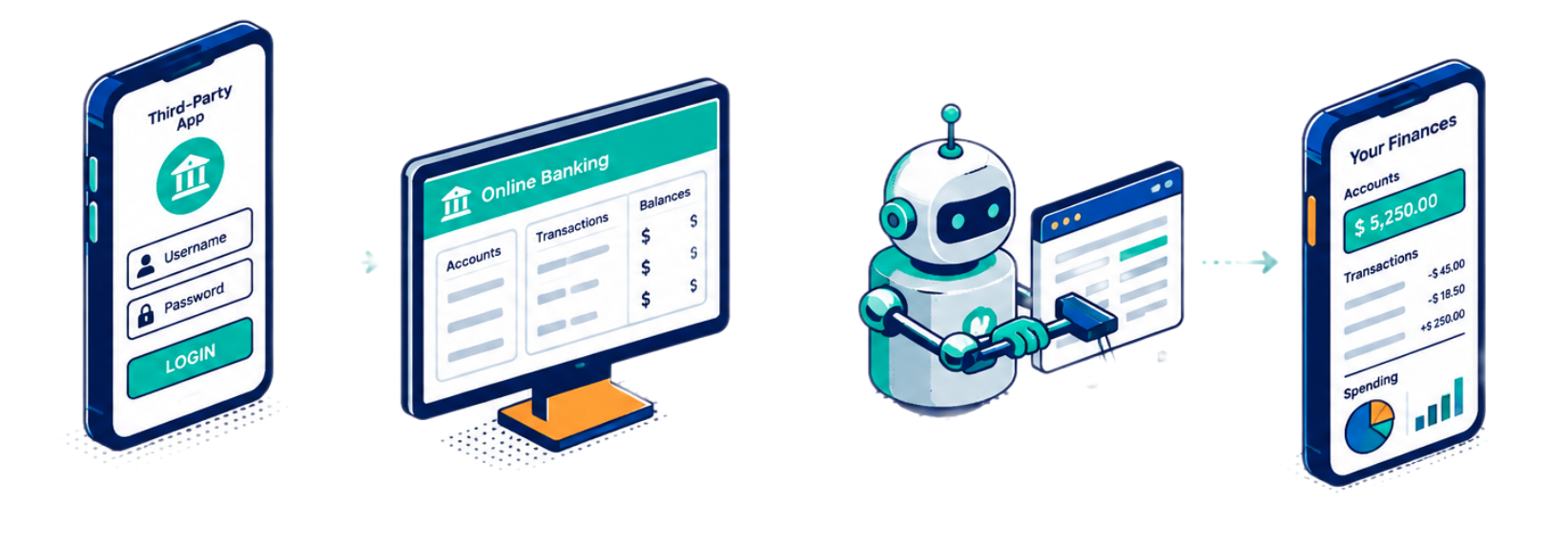
Screen scraping helped accelerate early financial connectivity, enabling consumers to link accounts with budgeting tools, payment apps, and other digital services before standardized banking APIs were widely available. However, as digital ecosystems expanded, financial institutions faced growing challenges around visibility, reliability, and managing user-permissioned data access at scale.
Because screen scraping often required consumers to share full online banking credentials with third parties, institutions also had limited ability to control how much data was accessed or monitor how credentials were handled after authentication.
Changes to online banking interfaces could disrupt connections, creating inconsistent experiences for users. At the same time, evolving regulatory expectations increased the need for stronger consent management, transparency, and more standardized data-sharing approaches.
As the industry continues to evolve, these needs are helping drive broader adoption of open banking and API-based connectivity models designed to support more secure, resilient, and scalable data sharing.
The industry’s response has been a shift toward open banking, an approach centered on secure, standardized banking APIs that allow data to be shared directly between financial institutions and third-party providers.
Unlike screen scraping, open banking APIs eliminate the need for users to share their banking credentials. Instead of broad credential-based access, APIs enable permissioned data sharing that limits access to only the information consumers explicitly authorize.
Instead, users authenticate directly with their financial institution and grant explicit permission for specific data to be shared – creating a more secure, transparent, and controlled data exchange.
On the backend, the difference is substantial. APIs establish structured data pipelines, enabling consistent, real-time access without relying on fragile front-end interfaces. Financial institutions regain visibility into data requests, while third parties receive cleaner, more reliable data streams.
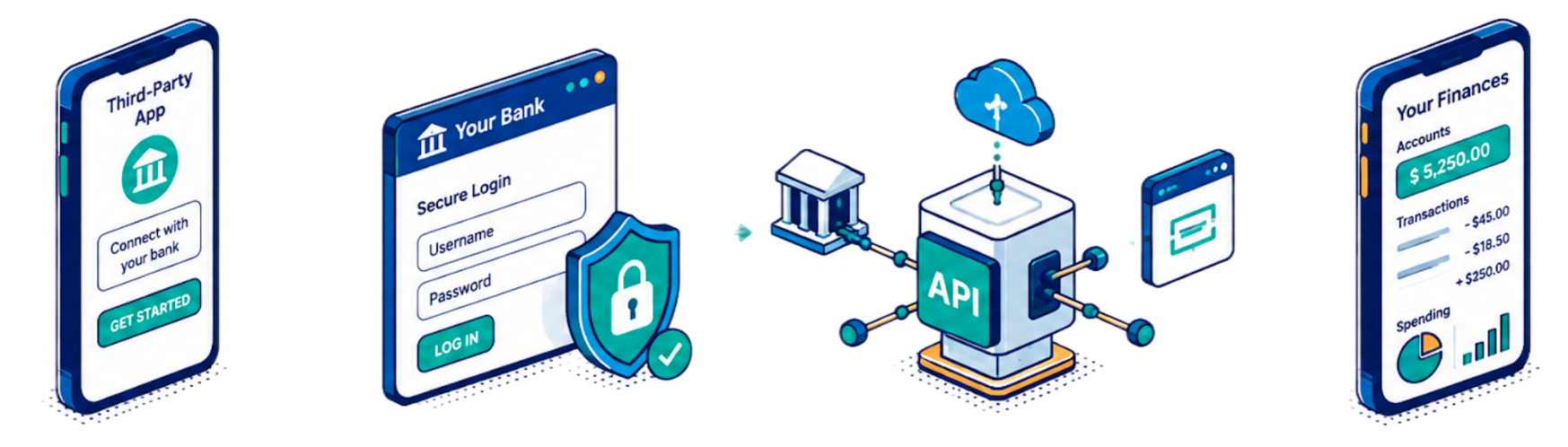
For digital banking users, the shift to APIs is immediately noticeable.
Connections are faster and far more reliable. Instead of frequent disconnects, users experience seamless, persistent integrations with their favorite financial apps. Authentication flows feel more secure, often leveraging familiar financial institution login experiences rather than requiring credential sharing.
For financial institutions, Banking APIs provide greater control and insight. They can monitor connection attempts, manage permissions, and ensure compliance with evolving regulatory expectations.
And for fintech providers, APIs offer consistency, reducing the operational burden of maintaining screen scraping connections across thousands of financial institutions.
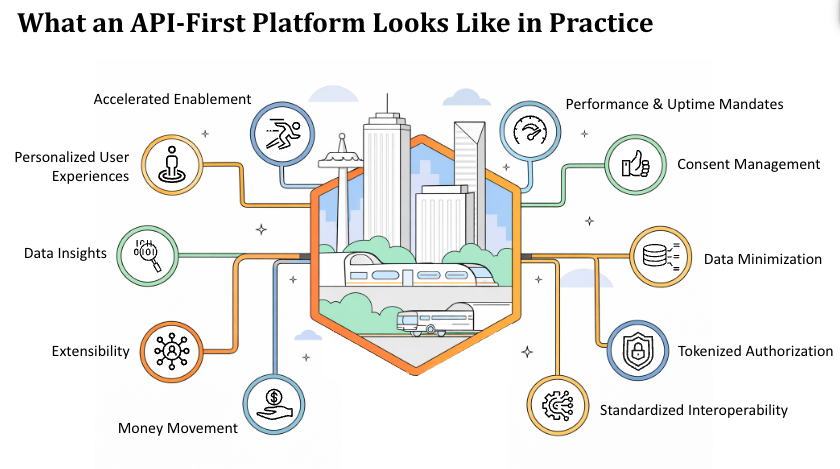
Data aggregators like Plaid and Yodlee have played a pivotal role in this transition.
Initially built on screen scraping, these platforms have evolved alongside the industry, investing heavily in API-based connectivity and partnerships with financial institutions. Today, they act as intermediaries that facilitate secure data exchange at scale, helping bridge the gap between banks, credit unions, and fintech apps.
Their evolution reflects the broader industry trend of moving from workaround solutions to purpose-built infrastructure powered by open banking APIs.
Early API connectivity initiatives between financial institutions, aggregators, and digital banking solution providers demonstrated meaningful improvements in reliability, visibility, and account holder experience compared to traditional credential-based connection methods.
During early beta programs conducted with participating financial institutions and Alkami, organizations observed significantly higher connection success rates (defined as the percentage of successful account-linking attempts completed without credential failures or connection interruptions) when using API-based connectivity versus screen scraping methods for linking financial data to external apps and services.
In some reported beta program results, moving from traditional credential-based connection methods to API integrations increased connection success rates to as high as 99.9%, highlighting the reliability improvements associated with direct API-based connectivity.
Beyond connection performance, participating financial institutions also gained improved visibility into connection attempts and third-party access activity — capabilities that were often limited with screen scraping approaches. Increased transparency helped support stronger security oversight and improve account holder confidence in data-sharing experiences.
During early API beta programs with participating financial institutions, API-based connections achieved reported success rates as high as 99.9% for linking financial data to external apps and services.
The move to open banking APIs is both an upgrade and a necessity. As consumer expectations rise and regulatory frameworks mature, financial institutions must provide secure, reliable, and transparent data access. Screen scraping, with its inherent risks and limitations, no longer meets those standards.
APIs represent a path forward that aligns innovation with accountability. They reduce fraud risk, improve system stability, and create a foundation for scalable, compliant growth in the digital ecosystem.
By enabling permissioned, authenticated access instead of shared credentials, APIs help financial institutions modernize connectivity while strengthening consumer trust.
Transitions of this scale can be complex, especially for financial institutions balancing innovation with account holder experience.
At Alkami, the focus is on helping financial institutions modernize their data access strategies without introducing friction.
“We’re helping financial institutions transition without disrupting the user experience.”
That means supporting API integrations, working alongside aggregators, and ensuring that as the backend evolves, the frontend experience remains seamless — or better yet, improved.
Ultimately, the success of open banking is centered on delivering a safer, more reliable, and more intuitive financial experience for everyone involved.
Ready to modernize your data access strategy with secure, reliable open banking APIs?