Blog, Strategies
October 12, 2026
Generational Trends: A Playbook for Financial Institutions
How banks and credit unions can make digital experiences more relevant at every life stage The tradi...
Account holders today primarily manage their financial lives using digital banking solutions, but does that translate to business operators adoption of business banking solutions?
Regional and community financial institutions (RCFI) often serve small and medium-sized businesses (SMBs), and those entrepreneurs often attempt to make due with consumer banking solutions to operate. When these accounts eventually are found to lack needed controls, these business operators may not be ready for commercial banking platforms that are too complex or costly. If their RCFI does not provide a scalable solution to fit their business needs now and into the future, they gravitate toward megabanks and fintechs who offer streamlined business account opening and intuitive digital banking solutions.
For business bankers, success will come through wisely using data to uncover businesses operating within consumer accounts, as well as measuring performance across business banking solutions, to ensure they are effectively driving adoption and continued usage of the technology they invest in. Which is why, for the first time, The 2026 Digital Banking Performance Metrics Report, commissioned by Alkami Technology and authored by Cornerstone Advisors has been expanded to include an analysis of business banking.
The 2026 Digital Banking Performance Metrics Report reveals that for RCFIs business banking has a strong average enrollment (65%), with those in the 75th percentile achieving a very healthy 85% rate of adoption. Of those enrolled, 68-90% of businesses are active users.
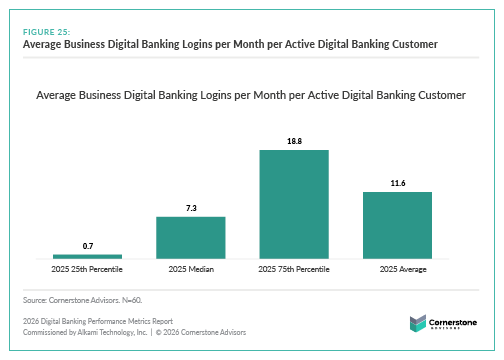
Where institutions diverge most sharply is login frequency. The average active business banking user logs in 11.6 times per month across web and mobile, but the gap between the 25th percentile (0.7 logins) and the 75th percentile (18.8 logins) is striking.
When it comes to mobile banking, adoption is modest, but business users engaged in mobile banking are loyal. On average, 31% of businesses are actively using mobile banking, however among mobile users, 75% are active, meaning mobile usage is concentrated among a smaller, yet highly engaged, cohort.
Digital account opening is often treated as a proxy for digital maturity, but the data tells a more nuanced story. In business banking, the capability itself is still far from ubiquitous according to the 2026 Digital Banking Performance Metrics report; only 17% of financial institutions reported being able to open a business checking account online, and at those that do, fewer than 25% of new business checking accounts are actually opened digitally. While institutions with online account opening capability average 127 new accounts per month versus 112 for those without it, the lift is incremental rather than transformative. Even among the industry’s most digitally advanced institutions, there is a gap between capability and adoption. Although 92% of Tech Titans (the most digitally mature cohort) offer online account setup, only 16% of accounts are opened that way, and half of those openings take more than two hours. The implication is that digital account opening may be an essential entry point, but it is not what ultimately defines success. The institutions setting the pace are the ones moving beyond digital acquisition alone to deliver the servicing, usability, and continuity that make digital relationships truly work at scale.
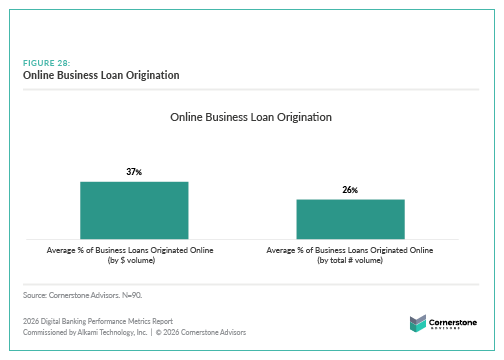
Among the few institutions that have made the investment, however, online origination accounts for a meaningful share of activity. Thirty-seven percent of business loan dollar volume and 26% of total loan count originated online. According to Cornerstone, the gap between the two figures suggests that online loans at these institutions tend to skew larger and those businesses seeking higher dollar amounts are completing the process digitally, which runs counter to the assumption that complex, larger small business loans require in-person relationships.
Business banking platforms are strong on the fundamentals — ACH origination, wire transfers, and Positive Pay are widely available; however, significant gaps remain in the capabilities that matter most to growing businesses. The pattern is consistent, showing transactional capabilities are reasonably well-covered, while the higher-order features that support cashflow management, receivables, payables, and real-time payments remainout of reach for most business users.
The Top Ten Business Banking Capabilities Offered at Regional and Community Financial Institutions Today
For the complete table listing thirty business banking solutions, how often they’re being offered now and frequency of appearing on an institution’s 2026 roadmap, or do not have a current plan to offer them, download the complete report here and turn to page 27.
When it comes to business banking, the biggest frustrations are operational and internal, not end user-facing. The pain points that rank highest aren’t about what business clients can’t do; they’re about what financial institutions can’t see. Without visibility into usage data and the ability to experience their own platforms through a client’s eyes, institutions are flying blind on a product they’re actively selling.
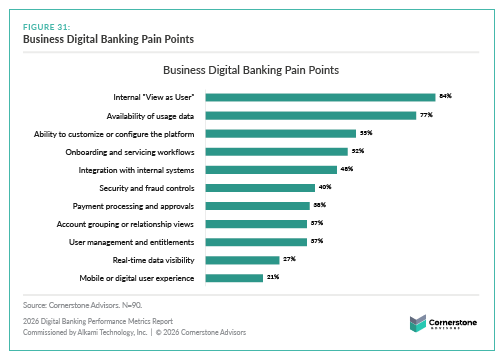
According to Cornerstone, what’s conspicuously absent from the top of the list is revealing. User experience ranks as a pain point for only 21% of institutions, and real-time data visibility for just 27%. Yet business mobile banking adoption sits at a median of 26% of business clients, and real-time payment capabilities are available at fewer than half of institutions surveyed.
If those gaps aren’t registering as pain points, it likely reflects an awareness problem rather than genuine satisfaction. Financial institutions may not be hearing from business customers who have simply stopped asking or haven’t yet encountered fintechs and larger banks offering something better. The risk is that by the time institutions feel attrition, the competitive gap will already be difficult to close, not to mention the time to implement new solutions that keep pace.
Financial institutions are being asked to support and sell business banking products they can’t fully see or measure, which has downstream implications for both service quality and platform optimization.
The business banking data tells a story that is earlier in its arc. Enrollment is solid, and the businesses that use digital treasury services use them actively. But the capabilities offered by institutions highlight significant gaps as—online account opening is rare, digital loan origination is nascent, and most institutions aren’t yet delivering the higher-order features that growing businesses increasingly expect: real-time payments, integrated payables and receivables, and cashflow forecasting.
The annual Digital Banking Performance Metrics report is intended to give banking executives perspective. Aware that there’s no limit to what a financial institution could measure, it is vital that each bank or credit union bases their measurement framework on their unique goals. The drum that this report will continue to beat is that there’s a true cost in measuring the wrong things or measuring the right things without knowing what action to then take with the insights.
1What is the current percentage of active business digital banking customers as a percentage of total, according to the 2026 Digital Banking Performance Metrics study?
The percentage of active business digital banking customers in 2025 was 78%. The 25th percentile is 68%, the median is 83%, and the 75th percentile is 90% active.
2What are the three essential components of a successful digital banking metrics framework, according to the 2026 Digital Banking Performance Metrics study?
Financial institutions need a digital banking metrics framework that accomplishes three goals: focuses measurement on outcomes, not just activity; connects digital performance data to business goals; and distinguishes between metrics worth tracking and metrics worth managing to.
3What are the top ten business banking capabilities offered at regional and community financial institutions today, according to the 2026 Digital Banking Performance Metrics study?