How data, artificial intelligence (AI), and execution are defining the next era of business and commercial banking solutions
The 2026 Update to the Business Banking Digital Maturity Model is an addendum to the original market research published in 2024. This refreshed study surveyed U.S. financial institutions to determine what separates leading banks and credit unions from their least mature peers, analyzing how they leverage culture, strategy, and technology to drive business results.
Developed by Alkami in partnership with financial services influencer Jim Marous and Emerald Research Group, the report paints a picture of the digital maturity spectrum by categorizing banks and credit unions into distinct segments based on their readiness and implementation of business banking solutions and commercial strategies.
|
Optimistic Believers Confident in their digital banking platform. Prioritizes investments in business end user experience. |
Emerging Pioneers Use digital for sales more than peers, and are in the early stages of building modern data technology. |
|
Cautiously Modernizing Compete with other local institutions. Invest less in tech than peers. Relies on experience for decisions. |
Tech Titans Their digital experience exceeds all other. Typically larger institutions whose sales approach is balanced across digital & branches and is data-driven. |
| Least Digitally Mature | Most Digitally Mature |
Building on the findings of the 2024 Report, the most recent research deep dives into advancements in data and artificial intelligence (AI), security measures financial institutions have taken to protect their account holders and themselves from evolving fraud threats, and streamlining the digital account opening experience.
Business banking digital maturity has moved beyond feature delivery. Financial institutions that connect data, workflows, and decisioning across digital account opening and onboarding, account servicing, and fraud prevention are pulling ahead. AI accelerates this shift, but only when built on clean, actionable data.
The most advanced financial institutions have rich and complete client data available for them to take action on, while less mature financial institutions have an opportunity to close the gap before AI can truly drive change in their organizations.
Financial institutions who have rich, complete client data readily available
| 10% | Cautiously Modernizing |
| 22% | Optimistic Believers |
| 62% | Emerging Pioneers |
| 71% | Tech Titans |
However, across the board, the majority of financial institutions have started leveraging AI agents within some aspect of their organization. Trust in an AI agent is dependent on complete, accurate data and the ability to make the right decision at the right time based on those actionable insights. For many digitally mature financial institutions, they’ve built a solid foundation and now they’re ready to use AI to unlock new efficiencies and growth goals.
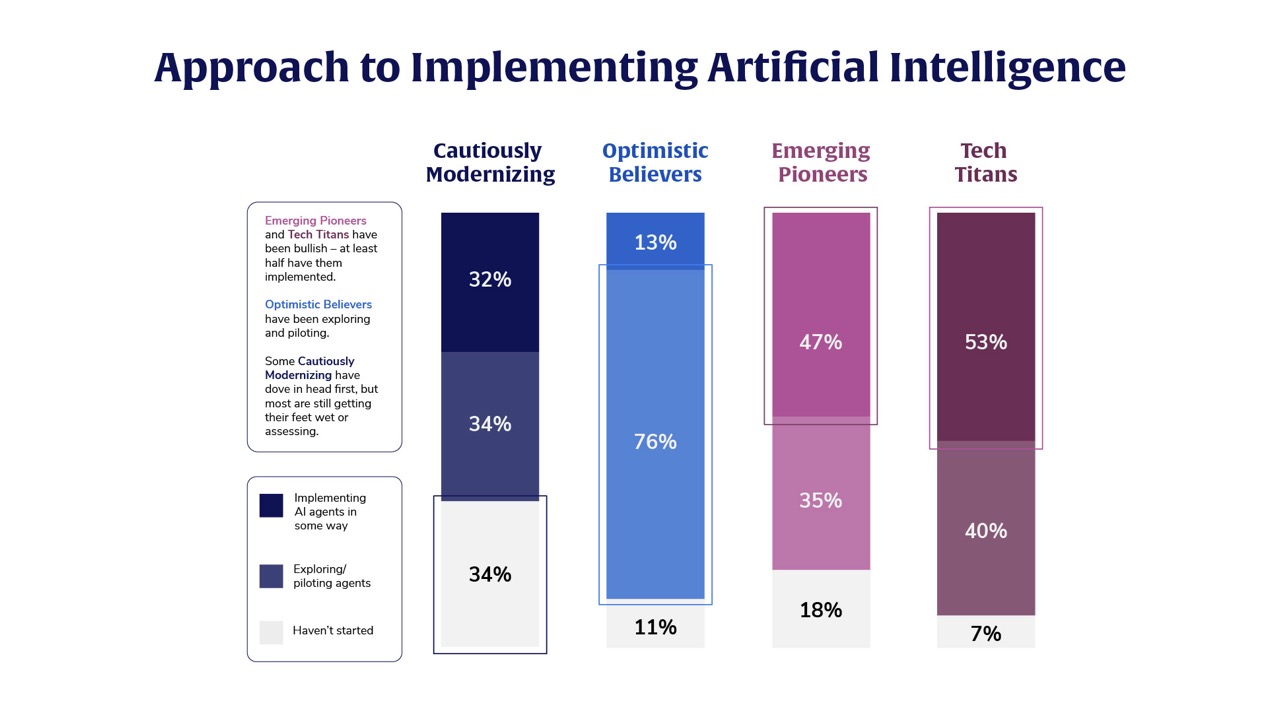
Many financial institutions are starting to use AI in parts of their organizations or are piloting it.
What are the top 3 priorities shaping business banking digital maturity in 2026?
This year’s report revealed three critical dimensions defining the next stage of business banking digital maturity:
- Digital account opening and self-service
- Reimagine how business and commercial applicants start relationships and how users operate once they’re in the digital banking platform. Connected workflows bring together identity verification, funding, and onboarding into a single experience. This integration reduces delays and drop-off, automates back-office processes, and helps prospective clients become active account holders faster than ever.
- Automated fraud prevention
- Move fraud controls to the earliest possible moment, before risk turns into loss. Intelligent automation surfaces suspicious behavior and transaction signals in real time. This strengthens fraud prevention at account opening and continuously monitors activity to stop threats early, lower false positives, and apply consistent protections at scale.
- Improved employee technology and deeper integrations
- Give teams the clarity, empowerment, and control to act without hesitation. With shared visibility across channels, streamlined workflows, and data that points to the right next step, employees can resolve issues faster, support complex needs with confidence, and take full advantage of the digital solutions in their toolkit.
Each of these priorities is superpowered by automation and AI, resulting in faster, safer, and more efficient experiences for both business and commercial clients, as well as operational teams.
This year’s model reinforces that digital maturity is not linear. Financial institutions modernize, optimize, and then recalibrate. However, the more a financial institution embeds a data-first mindset into their culture and execution, the more confidently it can automate decisions, personalize outreach, and prevent risk upstream.
See how your financial institution stacks up against industry peers by benchmarking your strategy.
FAQs
1What is digital maturity in business and commercial banking solutions?
Business banking digital maturity is defined by their culture which informs everything from strategy to execution and mindset. It reflects how effectively a financial institution uses technology, data, and processes to deliver seamless, efficient, and personalized experiences across onboarding, servicing, and fraud prevention.
2How can financial institutions improve digital account opening for business and commercial applicants?
Improvement comes from reducing friction, enabling omnichannel experiences, integrating with back-office systems, and automating identity verification and funding processes. Leading business account opening experiences enable applicants to start and resume the application across a variety of channels, simplify Know Your Business (KYB) checks, and seamlessly onboard the new user into the digital banking platform so they can finish setting up their account preferences and begin transacting.
3Why is data important for business and commercial banking transformation?
Data enables personalization, automation, and decisioning. Financial institutions with strong data foundations can act faster, reduce risk, and deliver more relevant experiences. Arming relationship managers with client data enables teams to outreach at the right time and provide 1:1 tailored guidance and recommendations.
4What role does AI play in digital maturity for business and commercial banking solutions?
AI accelerates automation, improves fraud prevention, and supports decision-making. Its effectiveness depends on data quality and integration across systems. Here are five high-impact AI use cases for business and commercial banking solutions.
5How do leading financial institutions differentiate themselves from other institutions offering business and commercial banking solutions?
The most mature organizations connect business and commercial banking solutions with third-party systems through deep integrations, unify and activate their dataset, and focus on building a culture of execution. Instead of adding more tools, they ensure every part of the experience works together to deliver measurable business outcomes.