Blog, Strategies
October 22, 2026
Check Fraud Moves Fast: How Financial Institutions Can Detect It Earlier
How layered intelligence helps financial institutions identify check fraud sooner and make more info...
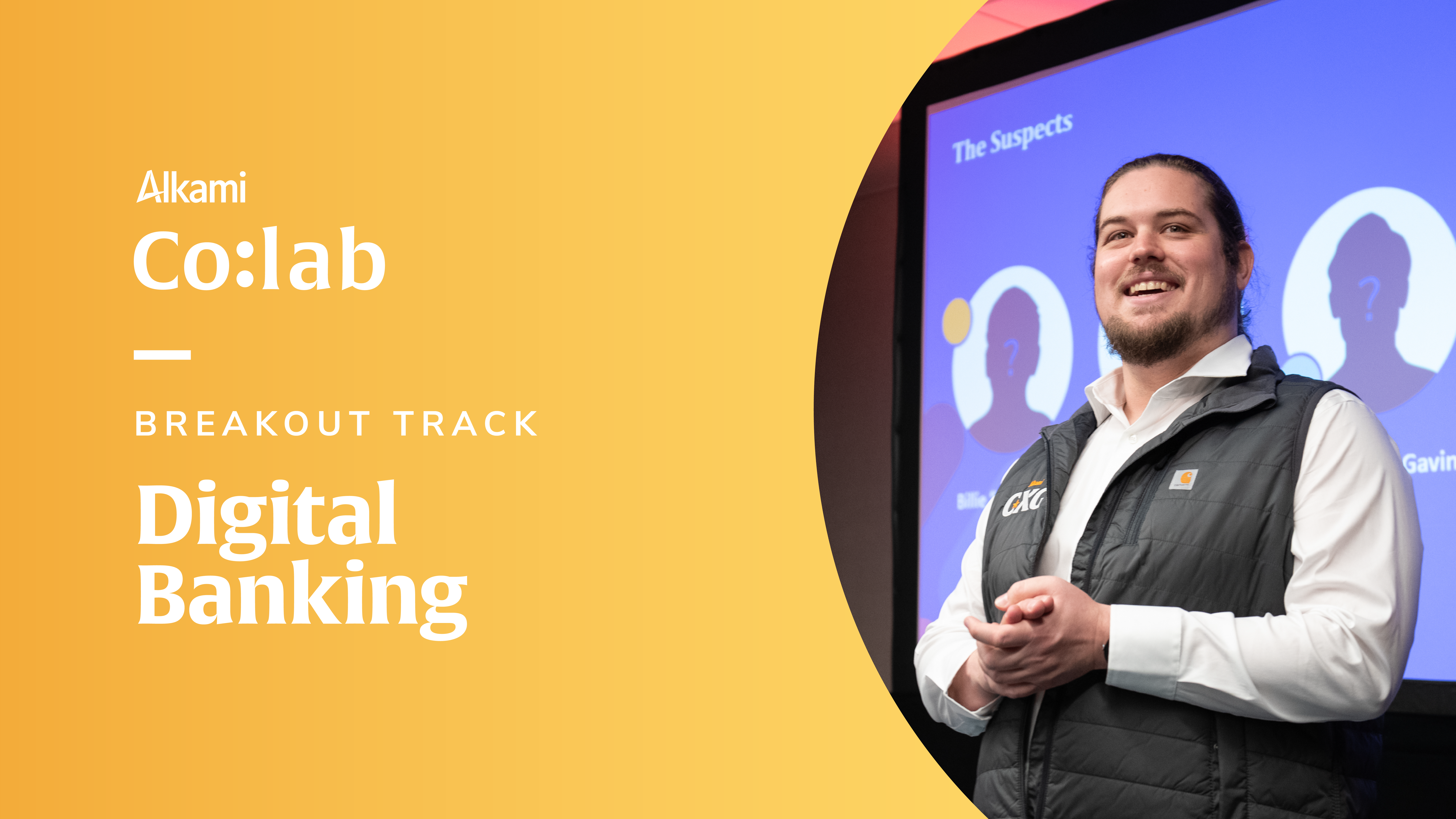
San Diego, you delivered the sunshine, the energy, and the big ideas at Alkami Co:lab 2026! From ocean views to bold conversations, this year’s conference brought together forward-thinking financial institutions ready to shape what’s next. Now, let’s rewind and dive into the moments that made the biggest splash!
Across Digital Banking sessions, attendees explored how to move faster, think smarter, and create more meaningful connections with account holders. From new innovations across the Alkami Digital Sales & Service Platform to fresh ways to turn data into action, the conversations were focused on one thing: making every interaction count.
In this recap, we’re breaking down the standout insights, strategies, and real-world perspectives shared by Alkami customers and industry leaders — so you can take what was discussed about digital banking solutions and put it into motion.
Building on The 2025 Update to Alkami’s Digital Sales & Service Maturity Model, Jim Marous of the Digital Banking Report and Banking Transformed Podcast, alongside Heather Bianchini of Unitus Community Credit Union and Grace Pace of Quontic Bank, discussed how financial institutions at different maturity stages turn data, culture, and process redesign into measurable growth, efficiency, and risk-managed digital transformation.
The conversation unpacked the four digital maturity cohorts for retail banking: Patiently Exploring, Innovation-Ready, Digital-Forward, and Data-First. Within these segments, the leaders generate 5x the annual average revenue growth than their least mature peers. Each banking leader talked about their experience taking the assessment and how their financial institution internalizes their results to build a strategic growth framework.
The takeaway for banking leaders was to benchmark your organization’s retail strategy, then intentionally re-architect a few high-impact journeys, such as digital account opening, fraud strategy, employee tools, and lifecycle marketing. To be successful in that effort, financial institutions must align culture and leadership to agree on priorities, remove points of friction, and establish a solid data foundation across partners and systems.
Attendees got a sneak preview of the insights captured in The 2026 Digital Banking Performance Metrics Report from Cornerstone Advisors, commissioned by Alkami. This annual study benchmarks how banks and credit unions are performing across their digital channels using operational data.
In this session, Ron Shevlin and Elizabeth Gujral, the lead researchers, unpack what separates top performers from the rest and how to close the gap. The report traditionally analyzes metrics across digital investments, digital banking operations, feature offerings and utilization. In 2026, a new section was added to include business and commercial banking metrics from enrollment to usage, across a wide scope of products and features unique to the client experience.
Cornerstone’s message to banking leaders is: what you measure—and manage to—now determines whether your digital banking platform becomes a growth engine or a stagnant cost center. The story of digital banking is no longer about whether financial institutions have embraced the channel, but whether they’re getting the most out of it, and if they can build a compelling enough platform for users to adopt and stay active. The winning financial institutions aren’t necessarily the ones spending the most. They’re the ones measuring the right metrics and behaviors, and acting on those findings.
Understanding what users do in digital banking is one thing but understanding why they do it is another. This session explored how financial institutions can bridge that gap, using better data, context, and tools to move beyond surface-level activity and uncover the behaviors that truly drive engagement and long-term value.
In this session, Lesly Fruge and Brent Dodson from Alkami, explored why digital engagement can be so difficult to interpret, and what financial institutions can do about it. Fruge framed the challenge by comparing digital interactions to in-person experiences, where cues like tone and body language guide understanding. As Dodson put it, “when we move that experience to the digital domain, we lose our senses,” leaving institutions with plenty of data but limited insight into intent.
The session introduced Alkami Engage through its framework (observe, learn, and optimize) and brought it to life through live demos. Attendees saw how dashboards, segmentation, and in-application (app) guidance can uncover friction and create opportunities to improve engagement. One example highlighted 734,000 monthly digital users, including about 200,000 Gen Z users, while another showed that users interacting with the credit score widget were trending roughly 17% higher on digital activity. Ultimately, having clearer insight into user behavior allows financial institutions to act with more intention, driving measurable improvements within the digital experience.
Financial institution leaders revealed how using Anticipatory Banking as a key component of their strategy replaces guesswork. Transforming digital interactions into timely, relevant engagements that accelerate growth, reduce friction, and continuously evolve to meet rising account holder expectations.
In this session, George Dow from Alkami moderated a candid discussion with Nick Bandoch from Tri City National Bank, Amy Krasikov from Raiz Federal Credit Union, and Kimberly Schmidt from Educators Credit Union. Each leader brought a unique perspective as they each were in a different stage of their journey with Alkami’s Digital Sales & Service Platform — from recent implementations to nearly a decade on the Digital Banking Platform. By leveraging behavioral signals, these institutions are recreating the human conversation digitally — delivering timely, relevant engagements that feel intuitive to account holders. Real outcomes underscored the impact, including reducing account funding times, achieving faster product adoption, and driving strong marketing campaign performance.
The Digital Sales & Service Platform is just the first step. Once the foundation is set, focus shifts toward a continuous loop of improvement. Leaders emphasized the importance of eliminating friction at every stage, from onboarding to day-to-day digital banking engagement, while empowering teams with data to validate decisions and uncover new opportunities. Treat digital as your primary experience layer, operationalize data to anticipate needs, and build a culture of rapid iteration.
Winning in modern payments is not about rails or buzzwords. Instead, it’s about owning everyday money movement through customer and member-led use cases, data-driven strategy, and disciplined execution.
This session brought together Ryan Waterman from Alkami, Richard Watada from the Federal Reserve, Char Sears from Unitus Community Credit Union, and James White from Engage fi to deep dive into how institutions can move the needle when U.S. consumers expect money to move as fast as their other daily-use apps. The discussion centered around what’s changing in the industry and how banking leaders can prioritize what steps to take next in their payments journey.
Rather than chasing the latest tech or fads like stablecoins, they discussed that leaders must start with account holder outcomes: “what moments in our customers or members’ financial lives feel broken right now?” Sears described how Unitus realized many of their members were already sending money abroad. They chose to bring those flows back into the trusted credit union experience by integrating a cross-border remittance service. White translated these stories into a playbook for banking leaders:
The conversation wrapped with an eye-opening conclusion. In a highly competitive market, banking leaders should shift their mindset from being the primary financial institution to becoming users’ primary transacting account — the place they default to when sending money, getting paid, paying bills, or supporting family across borders.
A successful implementation hinges on preparation, adaptability, and partnership. Institutions that embrace change management, align teams early, and commit to an iterative mindset can navigate obstacles, accelerate outcomes, and turn implementation into a catalyst for long-term growth.
This session, led by Katie Doll from Alkami, featured insights from Pam Villanova of American Eagle Federal Credit Union, Josh Essert of Tradition Capital Bank, and Chris Miller from Cornerstone Advisors, who unpacked what it really takes to successfully implement a new digital banking platform. Centered on the realities of execution, the conversation highlighted the importance of organizational readiness, clear ownership, and early alignment across teams. From staffing questions to data preparedness, leaders emphasized that success starts well before kickoff. Once implementation begins, institutions must shift from a linear mindset to an iterative approach — testing, learning, and refining in real time. This shift is essential for unlocking speed, reducing risk, and delivering meaningful outcomes.
While challenges are inevitable, how teams respond defines success. Whether navigating call center strain, internal confidence gaps, or unexpected hurdles, the ability to pivot quickly alongside a strong partner proved critical for both leaders who recently completed their digital banking conversions. The most effective teams invested in change management early, prepared their data and teams with intention, and embraced continuous improvement as a core operating model.
This session, moderated by Jim Perry from Market Insights, featured Monica Barker of Mascoma Bank, Christian Ruppe representing Colony Bank’s experience with Alkami’s Digital Banking Platform, and Nas Birmingham at SF Fire Credit Union, revealed that in a multi-relationship banking world, organic digital growth comes from precise engagement metrics, intentional onboarding, and focused, data-driven outreach — rather than the relentless chase of “primary financial institution” status.
Perry framed the challenge with fresh J.D. Power data: 1 in 5 customers moved money away from their primary bank over the last three months, and nearly half of new checking accounts are additions, not replacements. Put simply, consumers assemble banking like streaming services.
Panelists found that “active digital banking users” must be defined by behavior and product usage, not logins alone. The panel urged attendees to re-orient themselves from asking “are we primary?” to “are we the first destination when a banking need arises?” Then pick a few high-impact journeys like digital account opening, treasury onboarding, or certificate of deposit (CD) renewals, and invest deeply in frictionless paths that change the experience for users. These leaders emphasized being ready when the data signal fires so your financial institution consistently feels easier, more responsive, and more rewarding than the other two financial providers on your account holders’ phones.
Highlighting the real-talk of Generation Z (Gen Z) students from San Diego State University. Attendees discovered how young adults really choose their financial institutions, use digital tools, and seek financial advice — and what banks and credit unions must change to win and keep them.
Moderated by Annie Ackerman-Brown from Alkami, with insights from Sara Blake at Landmark Credit Union and a Gen Z panel — Addison Horn, Estabraq Al Khalaf, and Nathan Pascarelli, the discussion highlighted three consistent themes.
By conducting qualitative research with real Gen Z voices, financial institution leaders can uncover critical insights that resonate with this rising generation about how to redesign onboarding and everyday journeys, stand up credible financial-literacy hubs and parent-child experiences, and actively invite young adults into advisory conversations so your institution becomes their default guide.
Equipping leaders with a simple but rigorous framework for launch communications. By centering on one hard-to-reach persona and a single strategic goal, teams built end-to-end message plans that connect every channel and stage of the launch, transforming scattered tactics into a coordinated, measurable communication journey.
In Launch Kit Lightning, led by Deanna Maddox from the Alkami team, banking leaders were challenged to create a launch communications plan for the launch of a digital banking platform or a new product rollout. Working in small groups, participants chose a persona and defined their primary goal of their outreach. They then mapped persona-specific messages across launch stages and multiple channels, including email, SMS or push notifications, in-app content, call center scripts, direct mail, and website announcements.
Successful launch communications are designed around resolving friction, not simply highlighting new features. By explicitly naming the persona’s blocker (“I don’t have time for another login,” “I don’t trust this with my money”) and forcing every message to answer “what’s in it for me?”, financial institutions can turn one-off launch communications into a deeper relationship.
This guided session focused on designing thoughtfully segmented banking packages in the Alkami Digital Banking Platform. By working from realistic user scenarios and configuring limits, entitlements, and risk, teams learned how to turn ideas into concrete packages that tightly align experience, controls, and growth goals.
This session featured Fern Williams from Alkami, guiding cross-functional teams through a live challenge to build banking packages in the Alkami Digital Banking Platform. Participants worked with clearly defined retail and commercial personas — ranging from everyday consumer needs to complex treasury clients. They configured packages by selecting the right widgets, entitlements, security permissions, and transaction limits, then presenting and defending their decisions. Banking leaders walked away with a practical blueprint for disciplined product design: bring business, operations, risk, and technology stakeholders into the same room, use realistic personas and “friction points” to anchor the discussion, and collaboratively tune packages so that features, permissions, and limits are explicitly aligned, documented, and implemented.
Roundtable: Using Out of the Box Capabilities You Already Have
These interactive conversations explored everything from customizable dashboards, account and transaction filters, alerts, secure messaging, and self-service maintenance, to financial wellness tools, retail and business wires, ACH, auto-billing, multi-level approvals, and UpTiq-powered business insights.
In this interactive roundtable, peers dug into how to unlock more value from their digital banking platform across both retail and business banking solutions. The focus was how simple configuration changes to things like the content management system and transaction limits translated into higher engagement, fewer calls, and better fraud and risk outcomes. Participants also tackled the internal side of the equation: where native features were underused by operational teams, what organizational barriers kept teams in “out of sight, out of mind” mode, and how to foster creativity across product, digital experience, operations, and marketing. Through real-world examples and sharing best practices, the session equipped leaders with practical ideas they could take home immediately.