
Banking Fraud Prevention in the Age of AI-Driven Elder Scams

Home » Blog » Perspectives » Banking Fraud Prevention in the Age of AI-Driven Elder Scams

Strengthening Banking Fraud Prevention to Protect Seniors from AI Scams

October is Cybersecurity Awareness Month, and we’re spotlighting the latest fraud threats targeting the banking industry. In this blog series, we’ll explore how financial institutions can stay ahead with smarter technology, secure digital banking practices, and a layered approach to fraud prevention.

Our next featured partner is Appgate, a cybersecurity company that’s redefining secure access and fraud prevention. Their 360° Fraud Prevention approach goes beyond traditional access controls by combining real-time threat detection, behavioral analytics, and dynamic risk evaluation. With a software-defined perimeter at its core, Appgate ensures that only verified users can access critical systems regardless of location or device. This coordinated, adaptive defense strategy helps reduce attack surfaces, prevent fraud across channels, and maintain seamless user experiences all without slowing down operations.

Generative Artificial Intelligence (AI) is transforming financial services, offering unprecedented opportunities for personalization and efficiency. Unfortunately, the same technology is being weaponized by criminals to supercharge scams that target older adults. The sophistication of these fraud schemes demands a decisive response from financial institutions to protect their most vulnerable account holders and reinforce digital trust.

We’ve all heard the stories. Some of us have even been the main characters.

  • A phone call from a loved one—or so it seemed.
  • An email about an account that needs attention, with all the right branding and professionalism.
  • A social media ad to purchase just the thing you’ve been looking for.

Gone are the days of phishing emails rife with spelling and grammar mistakes. Today’s scams are more complex than ever, believable even to the shrewdest eye. The elderly, who tend to have financial savings, own a home, and have good credit, often have the most devastating tales.

This new reality requires new thinking. Banks and credit unions can no longer stand behind the old line in the sand, where they were on the hook to reimburse account holders for fraud but not for scams. Given the increasing sophistication of scams and the heartbreaking stories of older adults who have lost their life savings, the “failure to protect” sentiment is high. Whether fraud occurs unbeknownst to the user, or funds are lost when an authorized account holder perpetrates fraud unknowingly, financial institutions are being held to a higher standard. This is especially evident in the new way we’re referring to these scams as “Authorized Push Payment (APP) Fraud.”

The Challenge: A Surge in Elder Fraud

Elder fraud is escalating at alarming rates:

  • In 2023, U.S. adults over 60 reported losses exceeding $3.4 billion to the FBI’s Internet Crime Complaint Center (IC3), an 11% year-over-year increase, with an average loss per victim of $33,915 (FBI, NY Post).
  • By 2024, losses surged to nearly $4.9 billion, with the average loss climbing to $83,000 (AARP, McKnight’s Senior Living).
  • The Federal Trade Commission (FTC), however, noted that only $1.9 billion in losses were formally reported to its agency in the same year. Since fraud against older adults is severely underreported across all channels, the FTC estimates true losses may have reached $61.5 billion (FTC Report to Congress).
  • Cases involving losses above $10,000 quadrupled between 2020 and 2024, and those exceeding $100,000 increased nearly sevenfold (FTC Data Spotlight 2025).

These statistics reveal an urgent truth: financial institutions must act now to stop AI-powered scams before they cause irreversible damage.

The Solution: Building Smarter, Safer Banking Ecosystems

Financial institutions have an opportunity—and responsibility—to lead with innovation. By combining threat management solutions, fraud protection frameworks and AI-driven detection models, banks and credit unions can reduce exposure while reinforcing trust. The key is to recognize that coverage across the entire online banking kill chain is the only way to truly provide protection.

Key strategies include:

  1. External threat monitoring
    • Detect and dismantle phishing sites, spoofed domains and malicious applications (apps) before they reach account holders.
    • Monitor the dark web for compromised credentials and card data linked to elder account holders.
  2. AI vs. AI: Fighting fire with fire
    • Deploy systems that identify anomalies in behavior, device usage and transaction flows to predict and prevent APP fraud.
    • Use victim insights from threat management systems to flag elder account holders at heightened risk of manipulation.
  3. Adaptive authentication
    • Apply risk-based authentication for high-value, high-risk transfers.
    • Simplify methods, using one-click push authentication, one-time passwords (OTPs), and/or biometrics, to ensure older adults have little friction completing legitimate interactions.
  4. Human + AI defense centers
    • Blend automated detection with expert fraud analysts.
    • Enable rapid intervention to freeze suspicious elder-targeted transfers in real time.
  5. Education with accessibility in mind
    • Offer simple, clear educational materials—short videos, alerts, and plain-language guides.
    • Partner with community organizations to raise awareness among seniors and their families.

The Impact: Strengthening Digital Trust

Data from our Security Operations Center (SOC) highlights how fraud threats evolved from H2 2024 to H1 2025—and why financial institutions must act decisively:
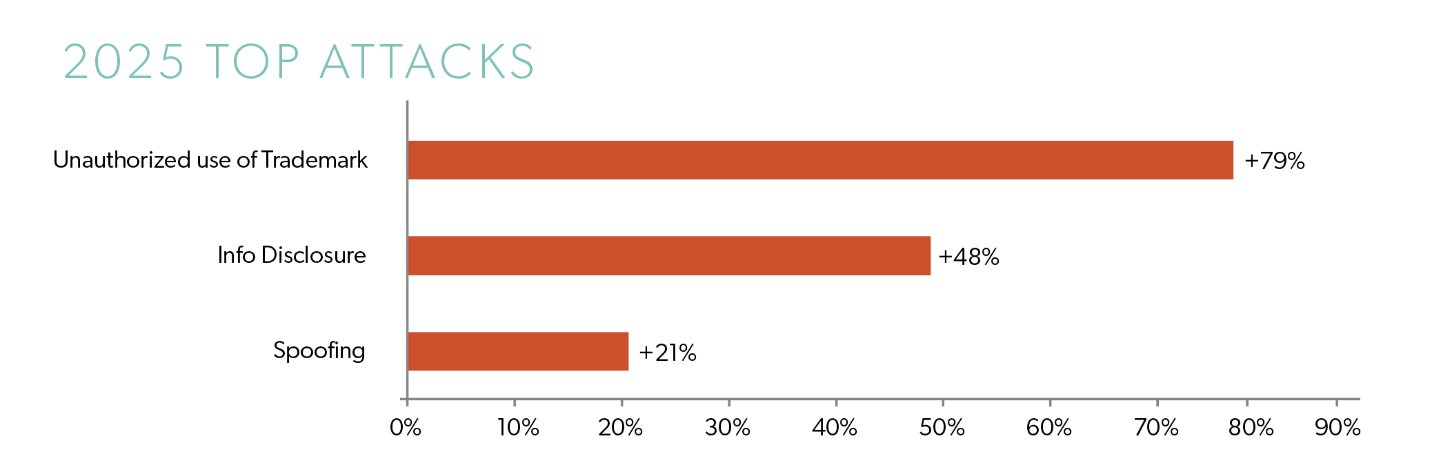
  • +79% increase in unauthorized trademark use: fake websites, apps and social media profiles imitating financial brands to steal account holder data.
  • +48% rise in information disclosure: leaked account holder data fueling account takeovers, fake loans, and SIM swaps.
  • +21% growth in spoofing: AI-crafted emails, SMS and chat messages that bypass traditional filters at scale.

In 2025, financial institutions are seeing a stark increase in banking security related to unauthorized use of trademarks, info disclosure and spoofing.

The reality is clear in that scams stay online longer (an average of 11 days) and spread across multiple channels, eroding trust and amplifying financial losses if not stopped quickly.

Preparing for 2026

As financial institutions build their 2026 cybersecurity strategies, three trends demand attention:

  1. AI arms race: Fraudsters will continue to weaponize generative AI, requiring institutions to invest in equally advanced countermeasures.
  2. Regulatory scrutiny: Expect increased compliance requirements focused on elder protection and AI-driven fraud detection.
  3. Trust as currency: In digital banking, trust is as valuable as any financial product. Institutions that champion fraud protection will win long-term loyalty.

Cybersecurity Awareness Month reminds us that secure banking requires more than technology—it requires leadership, foresight and action. Generative AI scams targeting older adults are a present and escalating threat. By adopting layered fraud protection, adaptive authentication, proactive threat monitoring, and accessible education, financial institutions can stop these scams before they succeed and ensure that every generation can bank with confidence.

Connect with an Alkami representative to learn how Appgate’s 360 Fraud Prevention can help your institution stay ahead of evolving threats with smarter, risk-aware security.

author avatar
Melissa Henricks VP Product, Fraud Prevention Solutions

LATEST Blogs

Never miss a beat in digital banking

J.D. Power 2025 Mobile App Platform Certification ProgramSM recognition is based on successful completion of an audit and exceeding a customer experience benchmark through a survey of recent servicing interactions. For more information, visit jdpower.com/awards.

Sign Up for information on Future Hackathon Events

Starter
Compliance

Catch fraud early
and reduce risk

Growth-
Oriented

Expand your commercial
capabilites

Advanced
Payment Security

Advanced protection
with revenue generation
Check Positive Pay Solutions
Payee Positive Pay
Check Positive Pay
Teller Validation
Reverse Positive Pay
ACH Positive Pay Solutions
ACH Positive Pay (debits)
ACH Positive Pay (credits)
ACH Credit Origination Protection
Reporting Solutions
Account Reconciliation
ACH Returns & NOCs
EDI Translation