Blog, Strategies
October 9, 2026
How Behavioral Intelligence Brings Precision to Account Takeover Detection
How separating genuine intent from fraudulent behavior stops account takeover in the digital banking...
If it feels like conversations around open banking application programming interfaces (APIs) are suddenly everywhere, you’re not imagining it.
Consumers now expect to connect their financial accounts to budgeting applications (apps), payment platforms, lending tools, accounting software, digital wallets, and investment services with just a few clicks. Businesses expect banking data to flow seamlessly into treasury and cash management systems. Behind these experiences is a major shift in how financial data moves, and how financial institutions support secure, modern connectivity.
That’s where open banking APIs and standards like the Financial Data Exchange (FDX) come into the picture.
For many banks and credit unions, though, the topic can still feel overly technical or difficult to unpack. What exactly are these standards? Why were they developed? What do they actually mean for digital banking strategy?
The good news: you do not need to be an API architect to understand why this matters.
Open banking APIs allow consumers and businesses to securely share their financial data with trusted third-party applications and services. The APIs act like secure bridges between systems, allowing them to exchange information in a structured and controlled way.
In banking, APIs make experiences like these possible:
Importantly, open banking APIs are built around consumer permission and control. Account holders decide when and how their data is shared and can revoke access at any time. This is a significant improvement over older connectivity methods that often relied on credential sharing and screen scraping.
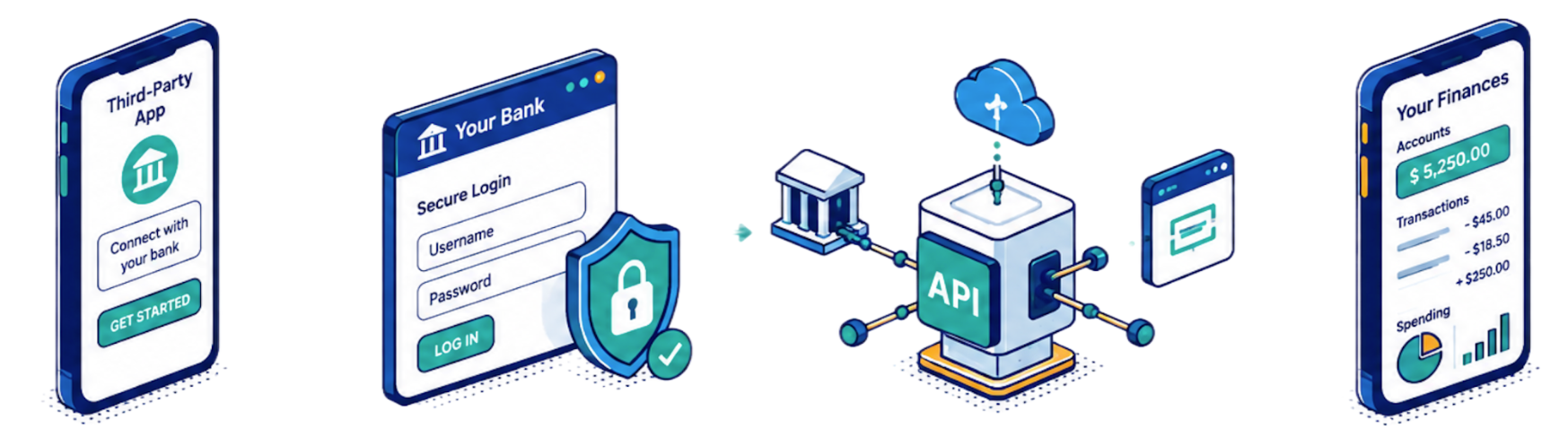
For years, financial connectivity lacked consistency. Integrations were often custom-built, data formats varied, and security practices differed across providers. In some cases, users had to share online banking credentials directly with third-party applications.
That created challenges for everyone involved:
As digital financial ecosystems expanded, the industry needed a more scalable approach.
That is why open banking APIs standards emerged.
API-based standards are shared specifications that define how organizations structure data, authenticate users, manage consent, and exchange information. Rather than creating unique integration requirements for every connection, institutions can rely on a common framework that supports secure, reliable, and interoperable connectivity.
Looking at the full HTML carefully, I can see the correct table has:
– Outer `div` with `border: 1px solid #e5e7eb; border-radius: 10px; overflow: hidden;`
– NO left border on the right column in `tbody` rows — just `border-bottom` on the `tr`
– A `border-left: 1px solid #e5e7eb` only on the `th` in the header, not on `td` cells
Here’s the corrected version:
One of the most widely recognized open banking standards in North America is FDX.
At its core, FDX creates a more secure and standardized way for financial data to move between financial institutions and applications. Rather than every provider building unique connection methods, FDX establishes common approaches for:
FDX helps simplify connectivity across the financial ecosystem while improving security, reliability, and transparency for consumers.
For financial institutions, API standardization extends far beyond technology infrastructure. It directly impacts the ability to innovate, integrate, and compete.
Consumers expect their accounts, apps, payments, lending experiences, and financial tools to work together seamlessly. Open banking APIs help make that possible by enabling more consistent communication across systems.
For financial institutions, standardized banking APIs reduce the need for complex, one-off integrations that require extensive development, testing, and maintenance. When providers follow common frameworks and specifications, connectivity becomes more scalable and repeatable, making it easier to launch new capabilities and adapt to changing consumer expectations.
This results in a more connected ecosystem, fewer integration barriers, and greater flexibility to innovate without constantly reinventing how systems communicate.
Standardization also strengthens the broader financial technology ecosystem.
Banks and credit unions increasingly rely on partnerships across:
Common standards help those ecosystems work together more efficiently.
That creates more flexibility for financial institutions and ultimately helps support better experiences for account holders.
Many consumers and businesses already use open banking capabilities every day, whether they realize it or not.
When someone links an account to a budgeting app, automatically syncs business transactions into accounting software, or securely shares financial information during a loan application, APIs are working behind the scenes.
As these experiences become more common, expectations continue to rise. When connectivity fails, consumers often associate that frustration with their financial institution, regardless of where the issue originated. That’s why open banking APIs have become an important part of delivering a modern digital banking experience.
While FDX is an important standard, it represents just one part of a broader transformation across financial services.
The industry is moving toward:
This shift is about meeting evolving expectations around how consumers and businesses interact with their financial data.
Adopting open banking APIs is only part of the challenge. Financial institutions must also keep pace with evolving standards, fintech partnerships, and connectivity requirements.
That is where the right technology strategy becomes critical.
At Alkami, we believe financial institutions should be able to focus on serving account holders, not managing the complexity of evolving API frameworks behind the scenes. Our approach helps banks and credit unions support secure, scalable, and connected digital banking experiences while reducing operational burden.
As open banking continues to evolve beyond FDX, the institutions best positioned for success will be those that can adapt without adding unnecessary complexity.
Ultimately, the conversation is not just about APIs or standards. It is about building a flexible digital banking foundation that helps financial institutions innovate faster, integrate more seamlessly, and meet rising consumer expectations with confidence.
1What are open banking APIs?
Open banking APIs are secure application programming interfaces that allow consumers and businesses to share financial data with trusted third-party applications and services. These APIs help banks, credit unions, fintechs, and digital platforms exchange data in a structured and permission-based way. Open banking APIs support experiences like account linking, digital payments, budgeting tools, lending applications, and business accounting integrations.
2What is FDX in banking?
FDX, or Financial Data Exchange, is an open banking standard designed to improve how financial data is securely shared between financial institutions and third-party applications. FDX provides a common framework for authentication, consent management, API communication, and data formatting. The goal of FDX is to create more secure, reliable, and standardized financial connectivity across the banking ecosystem.
3Why are open banking standards important for banks and credit unions?
Open banking standards help banks and credit unions improve interoperability, accelerate integrations, and support modern digital banking experiences. Standardized banking APIs reduce the complexity of connecting with fintech providers, payment platforms, and financial applications. They also help financial institutions deliver more secure, scalable, and seamless experiences for consumers and businesses that expect connected financial services.