Blog, Perspectives, Podcast
October 21, 2026
Local Roots, Big-Bank Expectations: AuburnBank’s Digital Strategy
How AuburnBank is connecting account opening, digital banking, and marketing engagement while preser...
Banks and credit unions looking to modernize their digital banking platform are increasingly evaluating how software architecture impacts agility, user experience, and continuous innovation.
Financial institutions face a difficult balancing act: deliver the kind of fast, intuitive digital experiences consumers and businesses expect while also managing security, compliance, operational efficiency, and long-term growth. As many banks and credit unions evaluate whether their current technology stack can keep pace, one foundational question is becoming increasingly important: What kind of architecture powers your digital banking software?
For financial institution leaders considering a digital banking platform switch, understanding the difference between single-tenant and multi-tenant architecture is a valuable place to start. The conversation should evaluate how quickly a provider can innovate, how efficiently financial institutions can scale, and whether the platform itself is built for the future of banking.
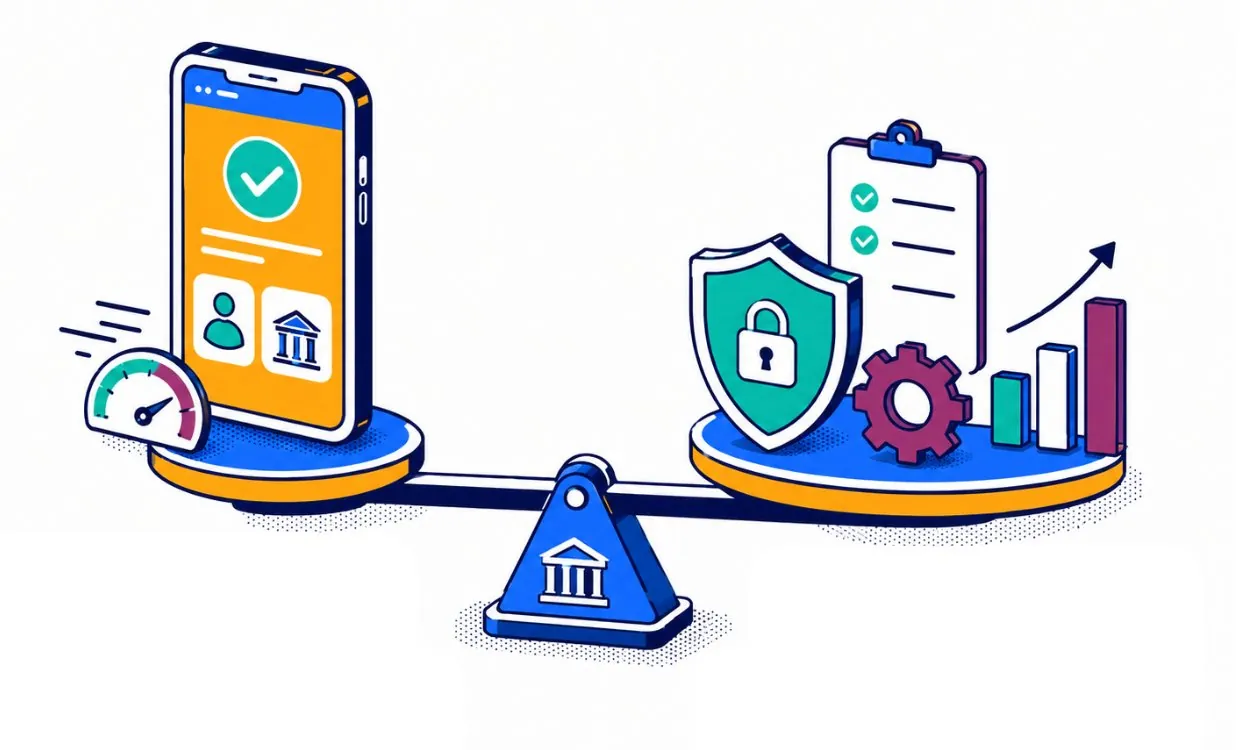
Historically, many financial institutions operated on single-tenant systems. In a single-tenant model, each institution has its own dedicated environment, infrastructure, and database. These platforms often offered a high degree of customization and isolation, which appealed to institutions that wanted greater perceived control over upgrades and configurations.
However, over time, single-tenant environments often create significant operational complexity at scale. As financial institutions adopt different software versions and follow separate upgrade timelines, providers must support numerous platform variations simultaneously. That fragmentation can make it increasingly difficult for software providers to maintain consistency across the platform, deliver updates efficiently, and isolate or resolve issues quickly when they arise. Over time, those inefficiencies can impact operational resiliency and slow financial institutions’ ability to respond to problems at scale.
As digital banking expectations accelerated, the limitations of that model became increasingly apparent. Consumers and businesses now compare their banking experiences not only to other financial institutions, but also to fintechs and digital-first brands that release new capabilities continuously. Banks and credit unions need digital banking software that evolves quickly, integrates easily, and supports innovation without creating operational drag.
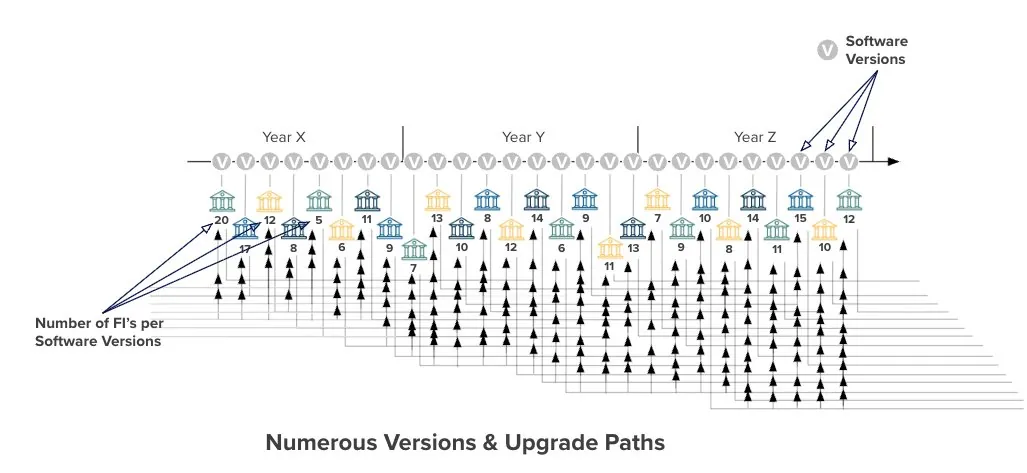
In Alkami’s former single-tenant architecture, fragmented software versions and upgrade paths introduced operational complexity.
Alkami experienced many of these challenges firsthand in our earlier single-tenant architecture. As our client base grew, maintaining separate environments became increasingly complex and resource-intensive. Like many modern digital banking providers, Alkami transitioned to a cloud-based, multi-tenant architecture to simplify operations, scale more efficiently, and deliver innovation more consistently across clients.
A multi-tenant digital banking platform is a cloud-native architecture where multiple financial institutions securely share a common infrastructure and core code base while maintaining strict data separation and security controls.
While “shared” infrastructure may sound limiting at first, modern multi-tenant architecture is designed specifically to create advantages in speed, scalability, resilience, and operational efficiency.
Instead of maintaining isolated environments for every client, providers can continuously improve a centralized platform and rapidly deliver innovations across their customer base. For financial institutions, that can fundamentally change how technology supports growth.
Single-tenant architecture still offers benefits in certain scenarios. Financial institutions may appreciate dedicated infrastructure, isolated environments, or the ability to manage upgrades independently. However, those benefits can also introduce tradeoffs.
Single-tenant environments often require:
On the other hand, multi-tenant digital banking software is typically designed for continuous delivery and cloud scalability. Updates can be rolled out more efficiently, infrastructure can scale elastically, and providers can invest more heavily in platform-wide performance, security, resiliency, and operational monitoring. Standardized environments can also simplify troubleshooting and accelerate issue resolution when problems occur.
In practice, that means financial institutions can spend less time managing technology and more time focusing on growth, account holder experiences, and strategic differentiation.
Single-tenant = Dedicated infrastructure with slower innovation
Multi-tenant = Shared infrastructure built for continuous innovation
Despite growing adoption, some misconceptions about multi-tenant architecture still persist in financial services.
“Multi-tenant platforms are less secure.”
Modern cloud-native, multi-tenant platforms are designed with strict logical data isolation, enterprise-grade security controls, and centralized monitoring. In many cases, providers operating at scale can invest more aggressively in cybersecurity, resiliency, compliance, and infrastructure optimization than financial institutions could independentl
“Customization is limited.”
Today’s leading digital banking platforms prioritize configurability and extensibility through application programming interfaces (APIs), integrations, software development kits (SDKs), and modular experiences. Financial institutions can still differentiate through branding, workflows, integrations, and personalized user experiences without maintaining entirely separate infrastructures.
“All financial institutions end up looking the same.”
Architecture does not determine differentiation, strategy does. The strongest digital experiences are often driven by how financial institutions leverage data, personalization, integrations, and engagement tools rather than by maintaining isolated code bases.
The demands facing financial institutions today make adaptability critical. Banks and credit unions are navigating rising expectations from consumers and businesses alike, intensifying competition from fintechs, increasing cybersecurity pressures, regulatory complexity, and ongoing resource and staffing constraints. Technology architecture directly impacts how effectively financial institutions can respond to those pressures.
A modern multi-tenant digital banking platform enables financial institutions to:
Just as importantly, multi-tenant environments allow providers to innovate continuously rather than through large, disruptive upgrade cycles.
Many leading technology companies already operate this way. Amazon Web Services (AWS), for example, is built on a multi-tenant model with multiple product verticals running on one shared platform. That structure allows AWS to innovate faster, scale efficiently, and deliver updates consistently across its ecosystem.
The same principle applies in digital banking. Multi-tenancy helps future-proof the platform by enabling faster innovation, stronger scalability, and quicker speed to market than traditional single-tenant environments. For financial institutions, this creates a more agile technology foundation that can adapt and grow alongside changing account holder and market demands.
Alkami’s digital banking platform is purpose-built as a cloud-native, multi-tenant solution designed specifically for banks and credit unions.
Rather than retrofitting legacy infrastructure, Alkami operates on a single code base with continuous software delivery, allowing financial institutions to benefit from ongoing enhancements without disruptive upgrade cycles.
Key components of Alkami’s approach include:
This shared innovation model allows Alkami to rapidly evolve the platform while helping institutions reduce operational complexity.
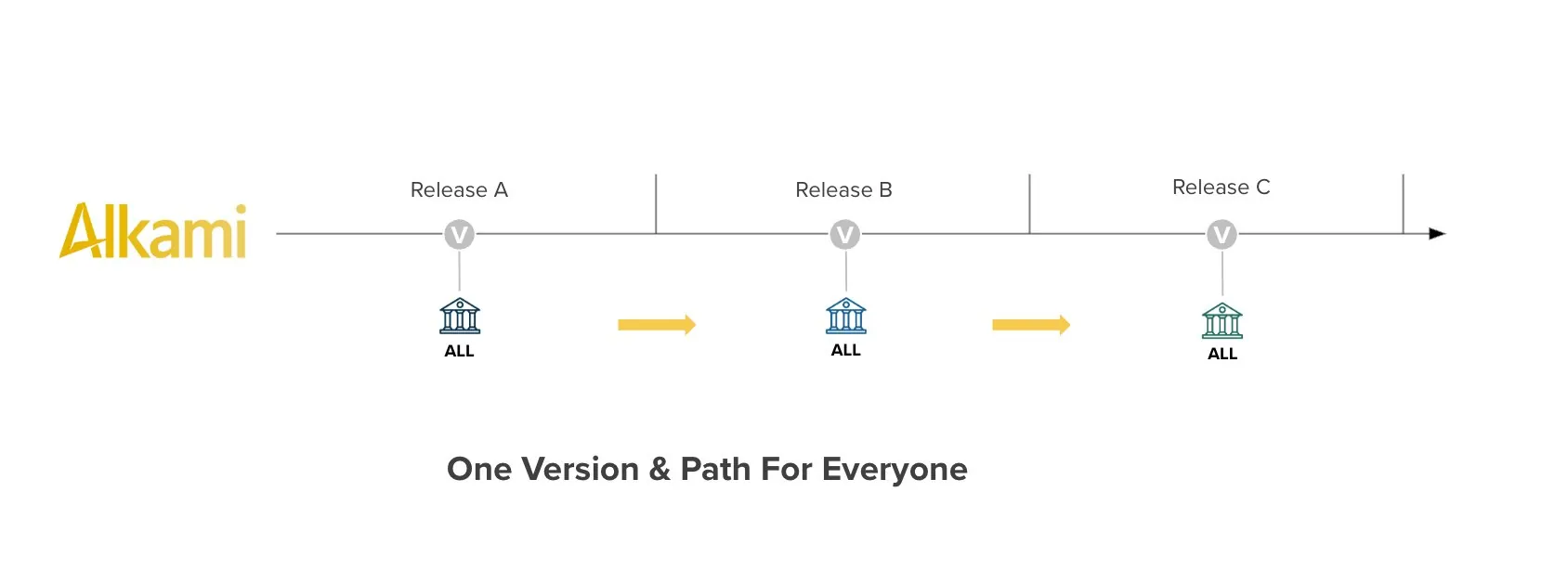
Alkami’s unified multi-tenant architecture simplifies versioning and delivers a consistent upgrade path across institutions.
As more financial institutions evaluate whether to modernize or switch digital banking providers, architecture should be part of the conversation from the start. While both single-tenant and multi-tenant models offer advantages depending on institutional priorities, the direction of the industry suggests that cloud-native, multi-tenant platforms are helping power faster innovation, greater operational efficiency, and long-term scalability.
Ultimately, digital banking architecture is a strategic one. For banks and credit unions looking to build stronger digital relationships, adapt to changing expectations, and remain competitive over time, understanding the foundation behind a digital banking platform may be one of the most important decisions they make.
1What is multi-tenant digital banking software?
Multi-tenant digital banking software is a cloud-native architecture where multiple financial institutions securely share a common infrastructure and code base while maintaining strict data separation and security controls. This model allows providers to deliver continuous updates, improve scalability, and reduce operational complexity for banks and credit unions.
2How does a multi-tenant digital banking platform differ from a single-tenant platform?
A single-tenant digital banking platform provides each institution with its own dedicated environment and infrastructure, while a multi-tenant platform uses shared infrastructure with logical separation between clients. Multi-tenant platforms typically offer faster innovation, lower maintenance overhead, and more efficient scalability.
3Why are financial institutions moving toward multi-tenant architecture?
Financial institutions are adopting multi-tenant architecture to improve agility, reduce IT burden, accelerate innovation, and deliver better digital experiences. As consumer and business expectations and competition from fintechs continue to grow, many banks and credit unions need digital banking software that can evolve quickly and scale efficiently.
4Is multi-tenant digital banking software secure?
Yes. Modern multi-tenant digital banking software is designed with enterprise-grade security controls, logical data isolation, centralized monitoring, and cloud-native resiliency. Many providers also invest heavily in cybersecurity and compliance capabilities across the platform.
5Can financial institutions still customize a multi-tenant digital banking platform?
Modern multi-tenant digital banking platforms support customization through APIs, integrations, configurable workflows, branding, and modular experiences. Financial institutions can create differentiated user experiences without maintaining separate infrastructure environments.
6How does Alkami use multi-tenant architecture?
Alkami’s digital banking platform operates on a cloud-native, multi-tenant architecture with a single code base and continuous software delivery model. This approach helps financial institutions gain faster access to innovation, improve scalability, reduce maintenance complexity, and deliver modern digital banking experiences.