Blog, Strategies
October 9, 2026
How Behavioral Intelligence Brings Precision to Account Takeover Detection
How separating genuine intent from fraudulent behavior stops account takeover in the digital banking...
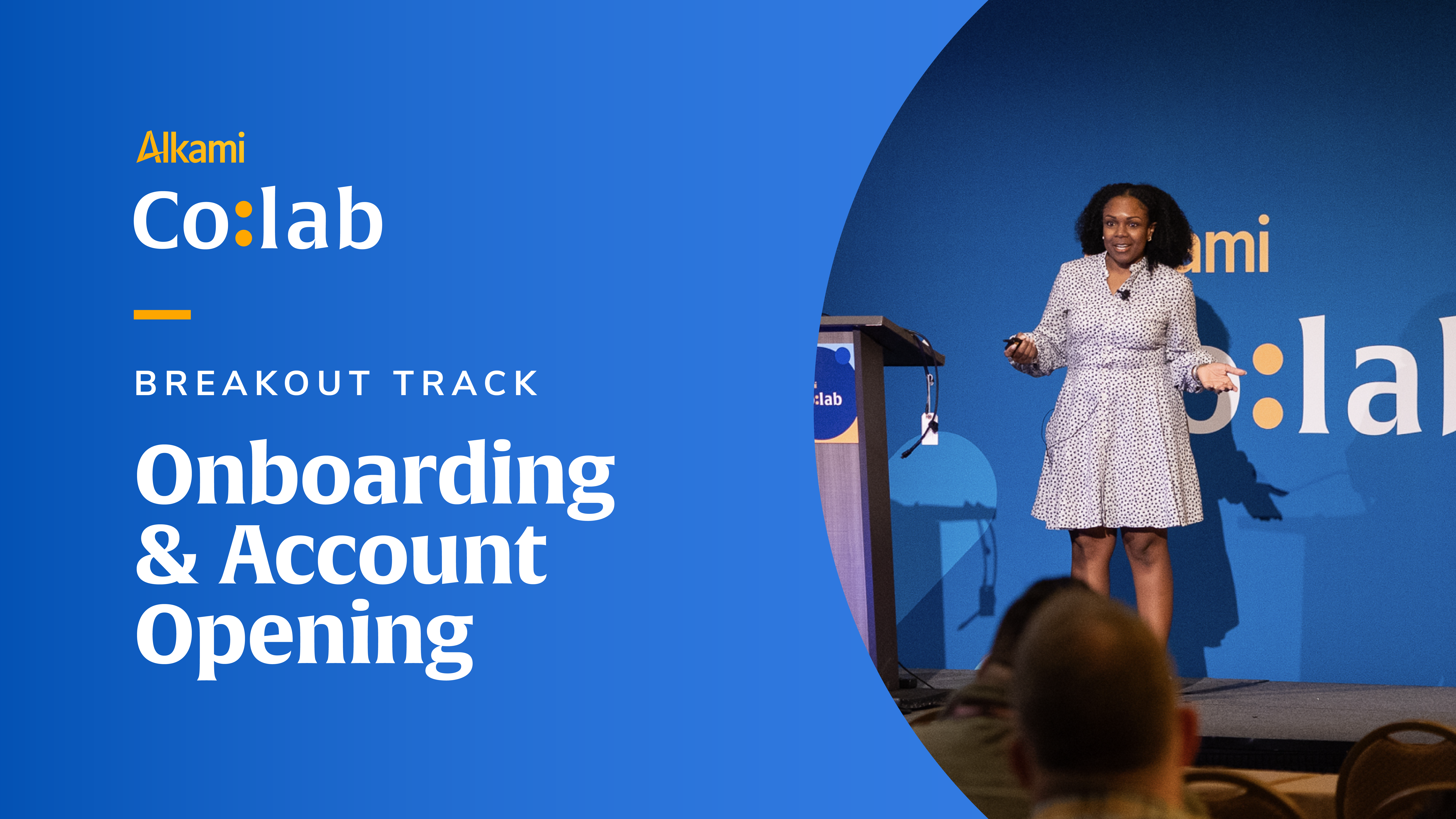
San Diego, you delivered the sunshine, the energy, and the big ideas at Alkami Co:lab 2026! From ocean views to bold conversations, this year’s conference brought together forward-thinking financial institutions ready to shape what’s next. Now, let’s rewind and dive into the moments that made the biggest splash!
This year, the brightest minds in banking gathered to move beyond the “status quo” and redefine what it means to be a community-focused institution in a digital-first world. Attendees walked away with strategies to accelerate growth, outsmart fraudsters, and transform the most critical moment in the account holder journey: the point of onboarding and digital account opening.
In this recap, we’re breaking down the standout insights, strategies, and perspectives shared by Alkami customers and industry leaders — so you can take what was discussed and put it into motion.
Industry innovators discussed why lending technology is no longer just a back-office function but a primary driver of institutional growth. The session featured Adam Cadmus (chief experience officer, The Atlantic Federal Credit Union), Amy Daniels (partnership executive, TruStage) and Adam Kingsmore (vice president, strategic sales, Alkami). Together, they explored how a unified platform for loan origination and deposit account opening can eliminate the fragmentation trap of legacy systems. By shifting the focus to a holistic digital account opening front door, institutions can meet modern borrower expectations while significantly reducing the operational risk inherent in manual, paper-heavy processes.
The conversation centered on the successful collaboration between The Atlantic Federal Credit Union (The Atlantic FCU) and MANTL during a cohort-based development process. Adam Cadmus highlighted that true modernization requires a “workflow redesign,” not just a digitizing legacy processes. By challenging legacy data fields and eliminating unnecessary applicant burdens, The Atlantic FCU was able to achieve a seamless “memberization” flow, where a loan application serves as a gateway to a primary financial relationship. Amy Daniels emphasized that leaning on integrated partners like TruStage allows for dynamic document generation and automated compliance, providing the “outside” perspective necessary to solve for exceptions without overcomplicating the standard member journey.
Organizational resilience is built on tech forward unified systems and intelligent automation. The session revealed that institutions can now automate almost all loan application decisions, mirroring the efficiency MANTL already provides for deposits, where retail account opening is 3X faster than the industry average. Whether through a full system replacement or an incremental approach using a modern API-driven Point of Sale (POS) solution, the goal remains the same: scaling without proportionally increasing costs while maintaining the human-centric service that defines community banking.
During the breakout session, speakers reframed fraud management from a back-office cost to a strategic growth driver. Featuring Grace Pace (Senior vice president/digital bank, Quontic Bank), Sara Seguin (principal advisor, Alloy), and Kevin Walsh (director of risk, MANTL), the discussion explored how automated decisioning can mitigate the “hidden growth tax” of fraud without stalling the applicant journey.
The panel highlighted Quontic Bank’s success in achieving nearly 100% automated digital account opening by treating fraud workflows as a living process. Grace Pace emphasized that while MANTL and Alloy provide the infrastructure to scale, institutions must actively manage their workflows to stay ahead of evolving AI-driven threats. A key innovation discussed was ongoing monitoring, where risk signals from the initial account opening are passed directly into digital banking to enable safer, high-limit transactions for trusted account holders.
For banking leaders, the takeaway is to shift from static, point-in-time checks to continuous, automated verification. To take action, leaders should audit current automation rates and integrate fraud analytics into broader growth strategies, ensuring they protect the institution while maintaining the seamless, three-minute digital experience applicants now demand.
Jessica Kephart (senior. director, service delivery, Alkami) and Jessica McNier (senior vice president, chief innovation officer, Financial Plus Credit Union) explored why even the best platforms can fail without disciplined rollout execution. They discussed moving beyond IT project plans toward technology as a leadership-driven cultural transformation. They reframed successful implementation as achieving a fast time-to-value by aligning internal champions and rethinking legacy workflows from the ground up.
The conversation centered on Financial Plus Credit Union’s (FPCU) journey to dismantle their infamous “100-step” in-branch process. Rather than merely digitizing a broken system, FPCU chose to rebuild the experience, reducing those 100 steps to just 15 and slashing account opening times from 30 minutes to just four. This strategic redesign bridged the gap between front-line staff and fraud teams, turning traditional internal tension into a unified effort that saved over 3,200 staff hours—equivalent to more than 400 employee days—now reinvested into deep member relationships.
The path to sustainable return on investment (ROI) has four pillars:
Financial institutions must move implementation out of the IT silo and treat it as a strategic initiative that mandates process questioning and leadership alignment. By prioritizing the employee experience alongside the applicant journey, leaders can ensure that new technology drives immediate, real impact rather than organizational friction.
David Carlson, vice president of new logo sales at Alkami, sat down with Scott Kosik, senior vice president, director of digital banking at Horizon Bank, to tackle a challenge that continues to hold institutions back: delivering a seamless business account opening experience without compromising compliance. What emerged was a clear shift in mindset. This is no longer a trade-off between risk and experience, it’s an opportunity to reframe business onboarding as a growth engine. As business expectations rise and competition intensifies, institutions that simplify and accelerate onboarding are better positioned to win high-value relationships from day one.
Horizon Bank’s journey brought this to life. Facing fragmented systems, manual processes, and error-prone workflows, the team recognized that business account opening complexity wasn’t just an operational issue, it was directly impacting growth, employee productivity, and the business client experience. By adopting the MANTL Onboarding & Account Opening Solution, Horizon Bank launched business account opening for the first time and transformed a 30–45 minute, branch-heavy process into a streamlined, omnichannel experience, reducing online account opening to just seven minutes and achieving over 80% automation. The result: business portfolio growth, stronger adoption across teams, and the ability to scale business deposits without adding friction. Just as important, frontline staff were freed up to focus on relationships instead of chasing documentation errors.
Business banking modernization shouldn’t focus on digitizing what exists today; financial institutions must redesign the experience around how businesses actually operate. Horizon Bank’s success underscores three critical parts of the MANTL business account opening experience: automate compliance to reduce risk and manual effort, adapt workflows to reflect the complexity of real businesses, and enable true omnichannel experiences that meet applicants wherever they are.
Dan Milgrom, vice president and chief customer officer at Alkami Solutions Group, and Ali Mattera, chief digital officer at ConnectOne Bank took the stage to discuss what omnichannel account opening actually looks like in practice, and why most institutions are still missing the mark. The conversation drew a sharp line between multichannel and true omnichannel: offering multiple ways to open an account isn’t enough. Real transformation happens when every channel operates as one continuous experience, eliminating friction for applicants and giving institutions a unified foundation for growth. In a market where fintechs have already captured trillions in deposits by delivering seamless experiences, the stakes for getting this right couldn’t be higher.
ConnectOne Bank’s story showed what’s possible when that vision is fully realized. By consolidating retail and business account opening across all channels onto a single platform, they replaced fragmented systems, manual workarounds, and limited visibility with a streamlined, data-driven growth engine.
Beyond speed, the shift enabled smarter growth: leveraging over 1,300 data points to optimize conversion, trigger automated follow-ups that now drive 50% of funding, and reduce acquisition costs by 30%. Just as critical, integrated fraud controls moved risk detection earlier in the process, protecting both the institution and the experience.
Omnichannel account opening is a strategic lever to onboard, engage, and grow relationships with precision. The path forward starts with unifying account opening across products and channels, then activating the data to continuously refine performance, re-engage applicants, and deepen existing relationships. Just as important is the internal work, aligning teams, driving adoption, and committing to a shared vision. Institutions that embrace this model are building a scalable, adaptable growth engine that meets account holders where they are and moves at the pace of their lives.
Dan Milgrom, vice president and chief customer officer at Alkami Solutions Group, joined Tami Brandenburg, vice president of member services at Dupaco Credit Union (Dupaco), to discuss the evolving role of the bank branch and how the industry is moving towards consultative branch experiences. The session showed that when institutions modernize in-branch account opening, the branch becomes a powerful growth engine, one that can deepen relationships, accelerate deposits, and create a more connected experience across every channel.
Dupaco’s results made that case tangible. By unifying in-branch retail and business account opening across all 23 branches, the institution saved more than 4,194 hours on front-end in-branch account opening, nearly doubled its annual deposit goal by the end of Q3 2025, and dramatically improved both speed and consistency. Consumer account opening dropped from 45 minutes to five, business account opening fell from as long as 90 minutes to about 13, and four out of five in-branch accounts no longer require manual intervention. Just as important, digitized workflows and instant funding options helped frontline teams keep momentum in the moment, rather than sending members away to complete steps elsewhere and risking attrition. What emerged was a stronger universal banker model, more time for coaching and advisory conversations, and a branch experience that is digital while force-multiplying the human connection.
Account opening can be a springboard for true branch transformation, and successful modernization is paired with disciplined change management. Dupaco underscored that this is not just a software rollout, it is a redesign of workflows, team roles, success metrics, and even member expectations. Institutions looking to act on these insights should focus on three moves:
The financial institutions that do this well will not just modernize the branch, they will turn it into a scalable advantage for growth, efficiency, and stronger relationships.
Led by Adam Carner, Senior Value Engineer at Alkami, this guided session walked attendees through the end-to-end account opening experience. They dove deep into the application experience from multi-factor authentication (MFA) to funding via Plaid or manual ACH — using sample data to simulate a real consumer experience. Attendees then shifted into the Banker Console to demonstrate opening complex business relationships, bulk account opening, enhanced due diligence fields, configurable ownership structures, and digital signatures.
MANTL’s benchmarks — under 5 minute time-to-open retail accounts, and under 10 minute time-to-open business accounts — show what’s achievable when you optimize for a frictionless applicant and banker experience, and automated risk decisioning rather than manual review by default.
Best practices translate directly into action items:
Financial Institutions that adopt this approach can benchmark their own funnels against these metrics, re-design both digital and in-branch journeys around an omnichannel workflow, and materially lift conversion, speed to book, and risk control during in-branch and digital account opening.
Justin Hall, Sales Engineer at Alkami, introduced MANTL’s performance and analytics dashboards as a way for banks and credit unions to gain real-time visibility into digital account opening key performance indicators (KPIs). Attendees completed a hands-on scavenger hunt that underscored the importance of analyzing data trends – including time to submit, automation vs. manual review rates, application breakdown by product and channel, funding amounts, and KYC approval/denial trends for new and existing account holders – and putting those findings into action.
The actionable playbook is to:
Adopting this discipline allows bankers to move from anecdotal debates about “what’s working” to targeted improvements in account opening journeys, marketing spend, and risk configuration, backed by real performance metrics.