Blog, Strategies
October 22, 2026
Check Fraud Moves Fast: How Financial Institutions Can Detect It Earlier
How layered intelligence helps financial institutions identify check fraud sooner and make more info...
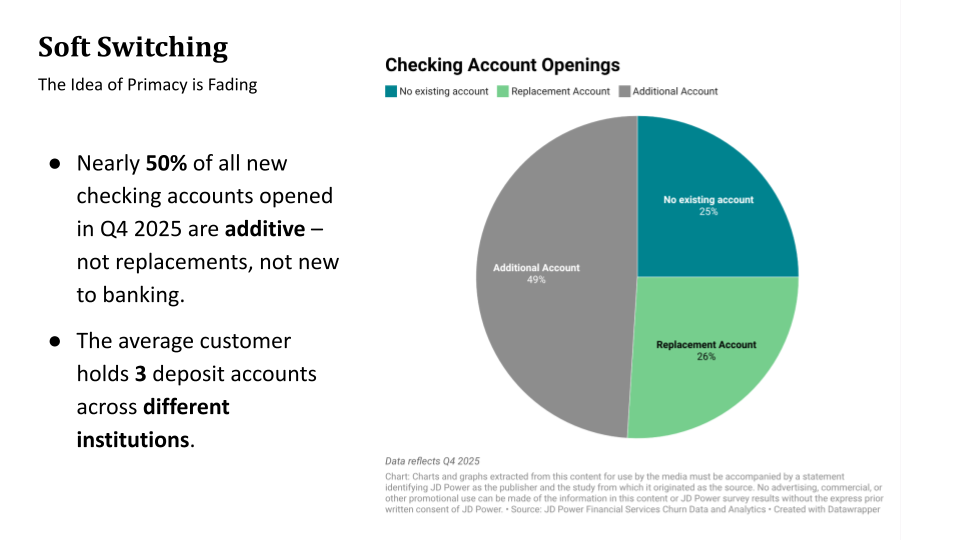
Today’s consumers maintain relationships with multiple financial institutions simultaneously. They open accounts without closing existing ones. They move money more freely. They build their financial lives the way they piece together a lineup of streaming services — picking providers for specific purposes.
For years, banks and credit unions measured banking relationship strength the same way: products per household, tenure, balances, whether they were considered the primary financial institution.
The problem is that’s not how consumers organize their financial lives anymore.
That reality raises a question worth sitting with: what does a real digital relationship actually look like today?

For decades, winning the primary checking account was the goal. The logic was simple — get the direct deposit, and deeper relationships would follow.
That logic still holds in some cases. But it’s losing its grip.
Consumers are increasingly keeping multiple checking, savings, investment, and payment relationships at the same time. Industry observers call it “soft switching” — customers and members aren’t leaving their institution; they’re just expanding their personal financial ecosystem. That’s a meaningful distinction, and it changes the strategic calculus.
The institutions that thrive won’t necessarily be anyone’s only provider. They’ll be the one that shows up at the right moment, solves the right problem, and earns the next interaction.
1 in 5 account holders moved money away from their primary financial institution in the past three months
Our panel on digital organic growth at Alkami Co:lab observed that many organizations still evaluate digital engagement through a short list of measures: logins, product adoption, enrollment rates, balances.
Those matter. But they don’t tell you much about the quality or depth of the relationship.
Here’s a simple test. Picture two account holders. The first holds three products but barely touches your mobile application (app). The second has a single checking account but uses it constantly — monitoring transactions, paying bills, moving money, engaging with alerts. Which relationship is actually stronger?
Increasingly, it’s the second.
Product count is a starting point, not an answer. What actually signals a real digital relationship is behavioral: direct deposit activity, regular mobile use, recurring bill payments, consistent money movement, engagement with financial tools. Those behaviors create a far more honest picture of how embedded an institution actually is in someone’s financial life.
A real digital relationship exists when a customer or member has integrated your institution into their financial routine. Not because they own multiple products, but because they actively rely on your institution to manage, move, monitor, and make decisions about their money.
If engagement is the foundation of a digital relationship, then the first 30 to 90 days after account opening may be the most important stretch of time in the entire customer or member lifecycle. While activation is important, those first 90 days should focus on establishing trust.
Too often, institutions treat onboarding as a transaction: account opened, welcome email sent, move on. That’s a missed opportunity. To keep an account from becoming dormant, you must encourage deeper engagement and resolve gaps that are keeping the relationship shallow.
The better approach is to watch for early behavioral signals. Has the account holderer set up direct deposit? Have they logged in? Are transactions actually happening? The answers reveal far more about future relationship value than any demographic profile.
The earlier you spot signs of disengagement, the better your odds of doing something about it before the account goes dormant.
The biggest shift in digital growth strategy right now is moving from reactive service to what Alkami calls Anticipatory Banking.
Historically, financial institutions waited for customers and members to raise their hands. An account holder would call about a refinance, walk in to ask about savings rates, or respond to an email or marketing mailer. The financial institution reacted. Anticipatory Banking flips that. It means using behavioral signals to recognize meaningful moments before the customer or member explicitly asks for help.
I’ve seen financial institutions, large and small, miss even the most common of signals: a customer pays off an auto loan, or a member discontinues their direct deposit. Maybe savings balances start climbing, or a large deposit lands. Each of those events tells you something. The question is whether your institution is paying attention.
This isn’t about sending more messages. It’s about sending the right one, at the right time, because you already understand what’s happening in that account holder’s financial life.
Building stronger digital relationships doesn’t require a technology overhaul. Most financial institutions can make meaningful progress with what they already have. Track direct deposit activation and behaviors that indicate the account holder is beginning to rely on the account — transfers, recurring payments, unprompted returns to the app. Watch engagement patterns in the first 90 days and flag dormant accounts early.
Then — and this part is critical — build processes that connect those signals to action. A signal no one acts on is just noise. Successful financial institutions are ones that consistently translate what they’re seeing in the data into timely, relevant outreach.
We talk a lot about trust in banking right now. I often remind clients that how you onboard a new customer or member is the first promise your institution makes — and trust grows when you keep that promise repeatedly. Onboarding isn’t just an administrative exercise. It’s a credibility one. Keep that promise consistently, and the relationship has a chance to deepen.
Why? Because now, consumers have more options. Loyalty is more conditional. Relationships are increasingly spread across multiple providers. But those same dynamics create an opening.
Financial institutions that define digital relationships around engagement rather than product ownership are better positioned to grow. Those that treat onboarding as the start of a relationship — not the end of a transaction — will build something more durable. And those that lean into Anticipatory Banking will be able to reach customers and members when needs emerge, not after a competitor already has.
In a world of soft switching, multiple banking relationships, and declining primacy, the institutions that win won’t be the ones with the most products. They’ll be the ones that become part of the financial routine. That’s what a real digital relationship looks like.