Blog, Strategies
October 12, 2026
Generational Trends: A Playbook for Financial Institutions
How banks and credit unions can make digital experiences more relevant at every life stage The tradi...
Account holders don’t think in terms of payment rails. They think in moments. Whether it is paying a loan on time or funding an account before a deadline, they expect a seamless experience from their digital banking platform. From their perspective, there aren’t separate payment initiatives. There’s just their relationship with their financial institution.
That’s why a unified payment strategy matters. It allows financial institutions to support both loan payments and real-time transfers within one consistent digital banking experience, even as multiple rails operate behind the scenes.
Real-time payment adoption is no longer a future-facing conversation. It’s unfolding now, and at a meaningful scale.
That expansion is translating into real usage. In Q2 2025 alone, the RTP® Network processed approximately 1.18 million payments per day, with transaction value rising significantly year over year. This evidence shows that instant rails are supporting substantive, high-value activity. Demand is equally clear from the business side. A 2025 Federal Reserve Financial Services survey found that 66% of U.S. businesses are likely to use instant payments if offered by their primary financial institution, and those that do report approximately 10% higher satisfaction with their financial institution than those that do not.
While instant payments are becoming an expectation, simply adding a rail does not automatically create a better experience. How those rails are orchestrated is what ultimately shapes trust.
Planned payment moments, such as recurring loan payments and scheduled transfers, are predictable and routine obligations that account holders build into their monthly rhythm. Time-sensitive moments feel different, and carry more pressure. Funding an account before a cutoff. Covering a shortfall. Moving money with immediate confirmation because timing truly matters.
Historically, financial institutions have supported time-sensitive and planned payments through different systems and modernization efforts. Loan payments evolved through ACH-based workflows and billing systems. Real-time initiatives emerged separately through the RTP network and the FedNow® Service enablement. But account holders don’t experience payments in silos. They experience them as one continuous financial journey.
When confirmation language varies, posting timelines differ, or status visibility changes depending on the rail, friction creeps in for the user. Not because the rails aren’t working, but because the experience isn’t aligned. Over time, that misalignment can negatively impact confidence, even if every transaction technically succeeds.
A unified payment strategy doesn’t mean every transaction needs to be instant, and it doesn’t mean replacing established loan payment processes that already work well. Instead, it’s about designing around intent.
Whether an account holder schedules a recurring loan payment or initiates a time-sensitive transfer, the experience should feel cohesive.
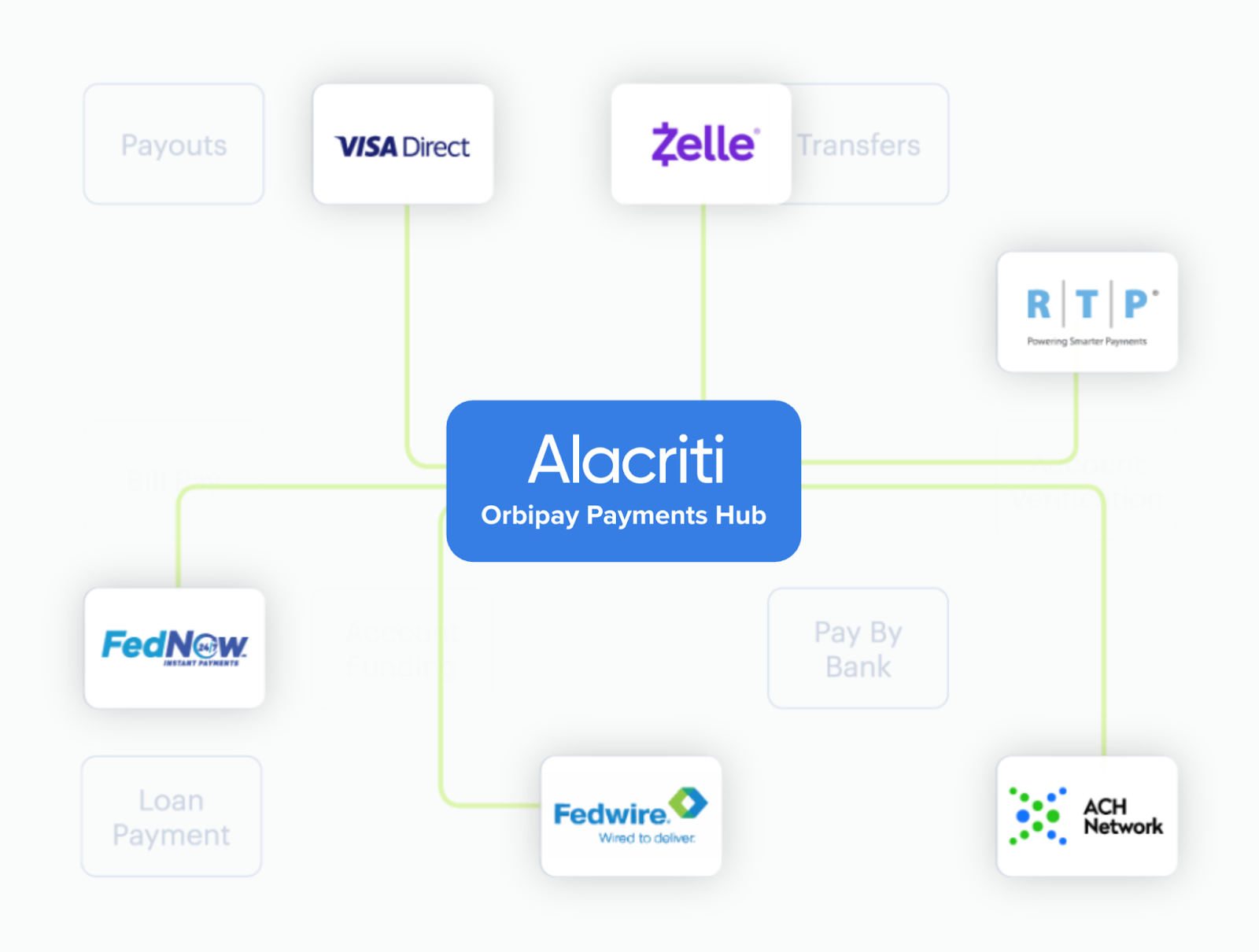
Within modern digital banking ecosystems, financial institutions can align front-end digital experiences with back-end orchestration across automated clearing house (ACH), the RTP network, and the FedNow Service. In that model, the rail becomes infrastructure and the experience remains unified
That distinction matters because payment behavior increasingly extends beyond the financial institution’s own channels. When account holders turn to external wallets, peer-to-peer apps, or third-party platforms to move money quickly or gain visibility, engagement fragments. A unified payment strategy helps institutions keep payment activity inside their digital banking experience.
As more payment options emerge, the strategic question is no longer simply whether to support them. It is how to support them in a way that strengthens, rather than dilutes, the primary banking relationship.
As financial institutions support more rails, complexity can grow quietly in the background for back-office teams:
These issues may seem minor individually, but over time, they increase operational complexity and reduce clarity.
Payment orchestration provides the connective layer;enabling intelligent routing across rails, centralized visibility, and consistent governance across recurring and real-time flows. The result is balance.
Account holders experience simplicity and clarity. At the same time, financial institutions maintain oversight and operational control. In a multi-rail environment, that balance is what makes modernization sustainable.
While orchestration manages how money moves, digital loan payment capabilities shape how account holders experience that movement. Recurring payments, guest payments, autopay enrollment, and digital billing interactions all live at the experience layer. This is where clarity of confirmation, ease of scheduling, and visibility into payment status matter most.
Loan payments are often one of the most frequent and relationship-defining interactions an account holder has with their financial institution. If that experience feels fragmented or inconsistent, trust can erode, regardless of how well the underlying rails perform.
A modern loan payment solution ensures that recurring and planned payment moments feel seamless, intuitive, and aligned with the broader digital banking platform.
A unified payment strategy does not equate to collapsing every capability into a single tool. Rather, it creates alignment among distinct layers of the ecosystem:
When these layers are intentionally aligned, financial institutions avoid silos without forcing artificial consolidation. Infrastructure remains flexible, and experiences remain unified.
How this alignment supports modern digital banking
Within Alkami’s Digital Banking Platform, integrated with Alacriti’s advanced payments solutions, financial institutions can:
This layered approach reduces friction without increasing risk. It enhances confidence without adding operational burden. The future of payments is not about choosing between ACH and real-time. It is about ensuring that infrastructure and experience evolve together,each playing a distinct role in serving account holder intent.
To explore how Alacriti’s coordinated loan payments and real-time capabilities can support a holistic payment strategy within your digital ecosystem, schedule a call or demo.
Come Meet Us At Co:lab
Alacriti empowers financial institutions to succeed now and in the future by providing innovative strategies and technologies. Our solutions are highly configurable and scalable, ensuring each institution can meet the unique needs of its accountholders.
At Co:lab, Alacriti will be available to share actionable insights and innovations designed to empower financial institutions in the digital age. From enhancing customer satisfaction with real-time payments to streamlining operations with our Orbipay Payments Hub and EBPP solutions, we provide practical strategies to help institutions stay ahead.