
Blog, Technology
April 3, 2026
AI-Powered Commercial Banking Solutions: 5 High-Impact Use Cases for Relationship-Driven Growth
How data-driven insights and artificial intelligence (AI) can strengthen commercial relationships by...
Banks and credits can no longer treat 24/7 service as an optional offering. It’s now a necessity. Digital-native banks have fundamentally shifted consumer expectations, capturing a significant share of new account openings by offering immediate, round-the-clock accessibility through modern digital banking solutions.
Financial institutions must offer always-on support without eroding the personalized, trust-based relationships that define them. This requires moving beyond simple “chatbots” to a sophisticated banking artificial intelligence (AI) workforce — embedded within a secure digital banking platform—that serves as a seamless extension of the human team, regardless of the hour or the channel.
Historically, financial institutions have faced a difficult choice for after-hours support: take on the high costs of internal staffing, outsource to expensive generic third-party call centers that lack institutional knowledge, or leave account holders to wait until Monday morning.
Now, there’s a new option: banking-specific AI integrated directly into a modern digital banking platform. This solution enables advanced digital banking solutions that complete complex banking tasks in real time. When integrated directly with the Alkami Digital Sales & Service Platform, AI navigates the banking core to autonomously handle balance transfers, transaction inquiries, and card management. This approach removes the friction of after-hours service altogether, allowing financial institutions to eliminate costly outsourcing while driving retention.
A banking AI workforce starts with a specialized layer of AI agents designed to handle domain-specific financial tasks across voice and digital channels. Unlike generic AI, these AI agents arrive pre-trained on banking-specific journeys and integrate into the core banking system through the institution’s digital banking platform to resolve complex inquiries agentically.
This workforce bridges existing service gaps, providing affordable, banking-specific virtual assistants that resolve inquiries on Sundays, holidays, and every night in between. With an AI workforce for banking, regional and community financial institutions (RCFIs) can out-service larger national institutions without the heavy cost of a third-party contact center or the stress of 24/7 staffing. By viewing AI as an extension of the workforce rather than a piece of software, executives solve the efficiency vs. experience tradeoff.
The banking AI workforce from Glia is trained on 1000+ banking scenarios. As a result, it understands the nuance of highly specific financial inquiries immediately upon deployment, welcoming end users into a secure environment where it quickly resolves up to 80% of inquiries.

Account holders do not see “channels”; they see one institution. They might start a search on their laptop at 10:00 PM, move to the mobile banking app to initiate a chat, and follow up via a phone call the next morning.
A channel-agnostic AI strategy ensures that users can switch from one communication mode to another without having to restart the interaction. Whether an account holder initiates a chat within the mobile banking app or calls the main branch line at midnight, the AI accesses the same banking core data to resolve issues or route the interaction with full context to a human agent the next morning. This unified experience ensures that the institution remains accessible and helpful at every digital and voice touchpoint.
Generic AI lacks banking context and is prone to hallucinations and user-initiated prompt injections. This makes it unsuitable for the highly regulated world of finance. Strategic financial institution leaders prioritize domain-specific AI built with banking guardrails.
Banking-native AI solutions understand the nuance of a “stop payment” versus a “disputed transaction”, and adhere to strict compliance protocols accordingly. At the same time, industry-leading solutions mitigate, or fully remove, the risk of hallucinations.
Glia, for example, uses a secure architecture purpose-built for the financial services industry to help prevent hallucinations. While generic AI solutions use generative AI to create responses during end user-facing interactions, Glia leverages Generative AI (GenAI) only during the authoring and vetting stages — before customers and members see responses — completely eliminating the risk of hallucinations.
As a result, financial institutions can confidently offer much more than a simple FAQs page for after-hours service. They can offer a banking AI workforce, where AI safely performs transactions on behalf of the user, such as moving money between accounts or updating loan payment preferences.
Transitioning to an AI-first support model directly improves the bottom line. By shifting routine, time-intensive manual work to a banking AI workforce, financial institutions free up employees to focus on high-impact initiatives such as deepening client relationships, driving revenue, and delivering strategic advisory value.
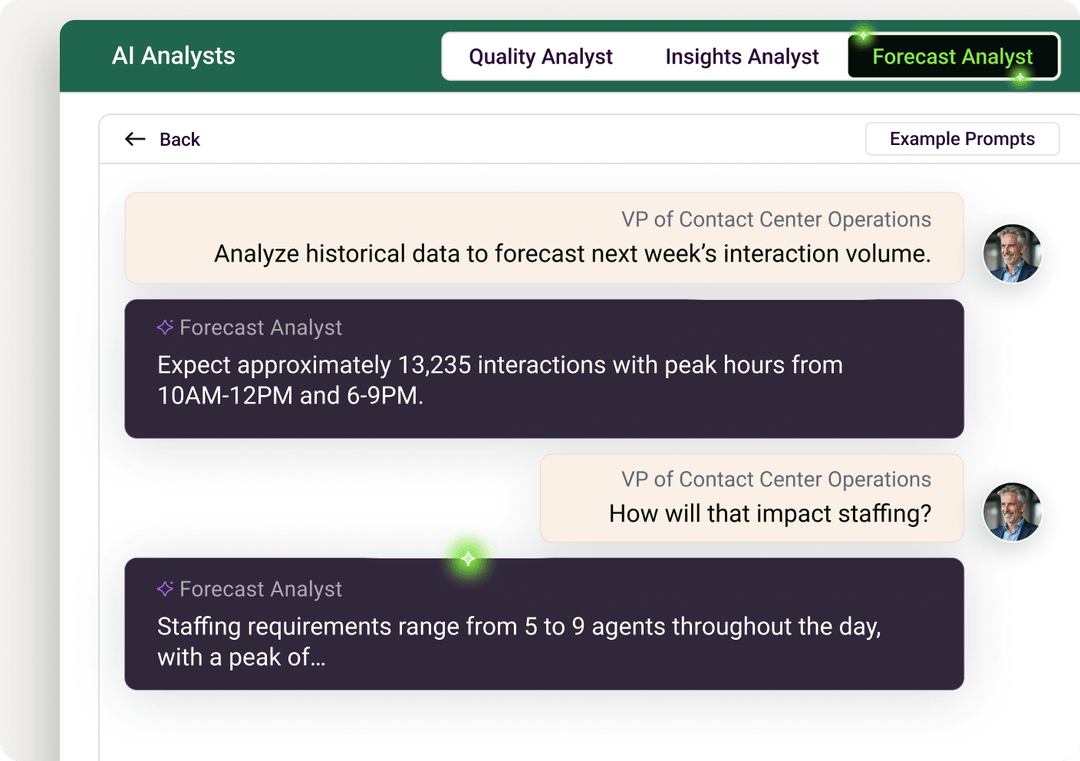
As we prepare for Alkami Co:lab 2026, the message for executives is that 24/7 support is the new baseline for service. By deploying a banking AI workforce that is integrated directly to the core and trained for the high-stakes nature of banking, regional and community financial institutions finally out-service fintechs and megabanks.
The future of banking is intelligent. By letting AI take the night shift, financial institutions empower their human staff to focus on the complex, empathetic interactions that help communities thrive.
Join Rachel Stratton, Director of Product Partnerships and Alliances at Glia, for her session: “The Banking AI Workforce: Meeting the 24/7 Customer Support Expectation” at Alkami Co:lab 2026. Discover how leading financial institutions are delivering efficient, around-the-clock digital and voice AI care without sacrificing the personalized touch your account holders expect.