Theodora Lau (00:05)
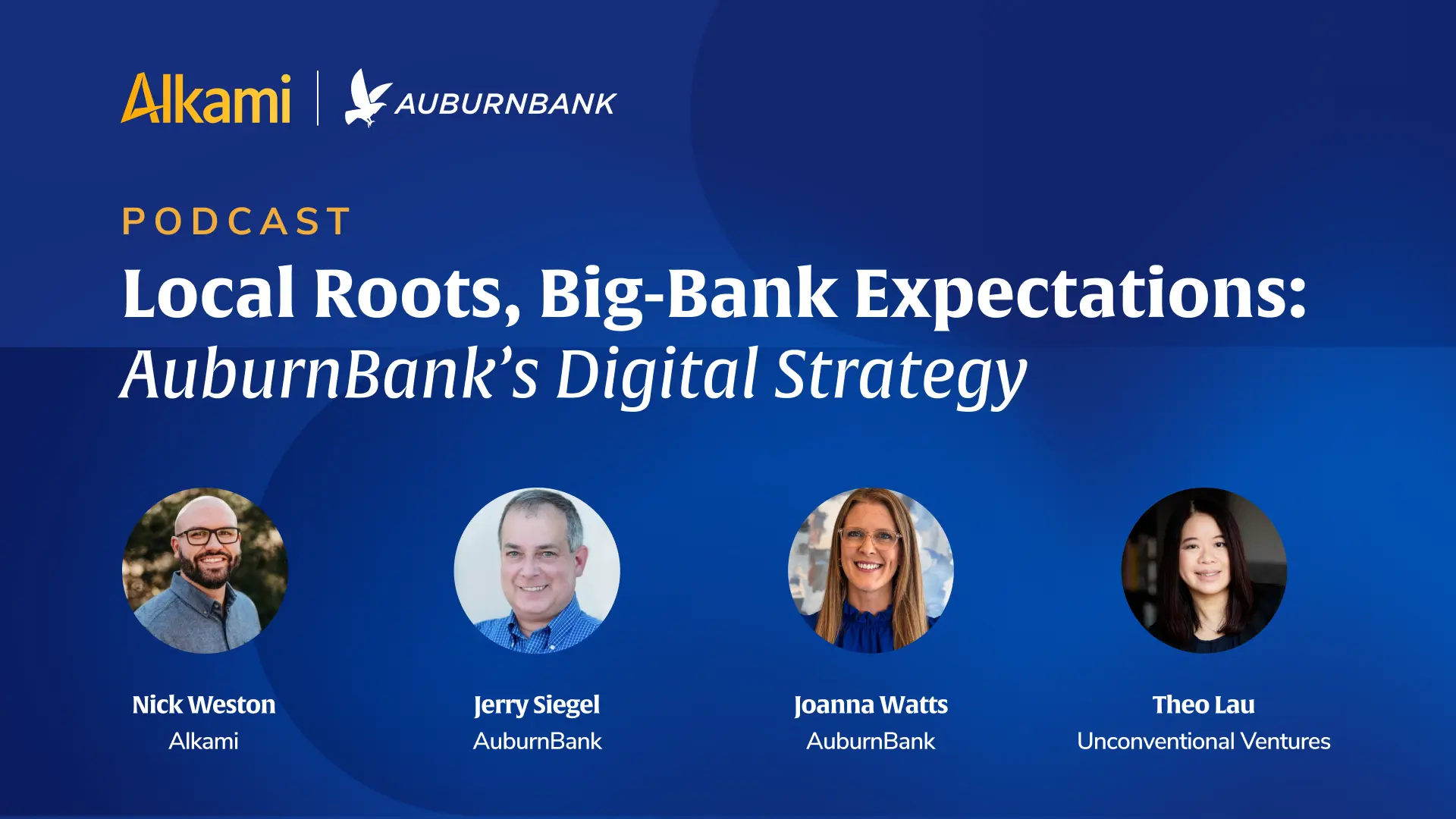
Hello everyone. Welcome to a brand new episode of One Vision. This is Theo, your host for today’s episode. Joining us on the on the show today, first we have Jerry Siegel, Senior Vice President, CTO of Auburn Bank We have Joanna Watts, Vice President Information Technology and Project Management at Auburn Bank And last,
But not least we also have Nick Weston, Senior Manager Product Management from Alkami Thank you so much for joining us, you all. We have quite a party today.
Nick Weston (00:43)
For having me.
Theodora Lau (00:45)
Yeah, so let’s start with a quick round of intros, if you don’t mind. if you don’t mind introducing yourself, share what you’re doing at the bank. We’ll start with you first, Jerry.
Jerry Siegel (01:00)
Good afternoon. I’m Jerry Siegel. I’m Senior Vice President and Chief Technology Officer for Auburn Bank. I’ve been here since two thousand and two. in addition to traditional IT roles, I oversee both Treasury Management Operations and Electronic Services, which in addition to debit cards wires, encompasses online banking and facilitating access for our customers.
Theodora Lau (01:27)
Thanks Jerry and Joanna.
Joanna Watts (01:29)
Joanna Watts, Vice President of Information Technology and recently project management. been here since two thousand and ten. And just like Jerry, I also hold another area which you know longtime bankers will know as proof data processing, you know, your check imaging area. So kind of oversee that one too, and really digging into some of the bank’s strategic goals this year, you know, and
trying to focus more on that project management side, which is all encompassing IT.
Theodora Lau (02:04)
Awesome and Nick.
Nick Weston (02:07)
Hey, Nick Weston. I’m a senior manager of product management here at Alkami I lead our digital sales and service platform and the strategy around that. Nice to be here.
Theodora Lau (02:18)
Thank you so much for joining. Before we start, Jerry and Joanna, I heard there is a story between the two of you guys. Someone told me that you might or might not have been working together for a very long time.
Joanna Watts (02:33)
An extremely long time. I think I was fresh out of high school. So 1996. he was already at the previous bank. and I started as a night sorter operator, you know. I don’t know if you remember that, where you used to have to sort checks. and then I think in ninety eight it was like, hey, you have a knack for computers. Are you interested in IT? And so that’s when I started getting into IT.
And Jerry, I think I don’t remember what year it is, he’d have to remind me, left to pursue other career opportunities and in twenty ten that bank had a buyout. And so of course, you know, with buyouts there’s layoffs and so I I called an old friend up and begged him for a job so I could stay in IT and so it it’s been many, many years.
Theodora Lau (03:27)
Okay. I love those stories. I think every one of us have one of those where you had a, you know, you you had the opportunity to work with someone that you know you like and your career paths just kind of intertwined and here you are, 2026 on the podcast together. I wonder if I would have asked you ten years ago if this is where you think you would be. What do you think?
Joanna Watts (03:52)
Probably.
Probably not on a podcast though.
Theodora Lau (03:56)
Well, I am very lucky and honored to be able to host you all here. So let’s start with the bank. because Auburn Bank has served the community for more than a century, I think. It’s been a while. so how do you balance that long of a history and you know, all of the customer relationships you have with the need to adopting with new technology?
Jerry Siegel (04:24)
Well, Theo, unfortunately we had gotten a little bit behind the technology curve, which we heard from our customers. You know, they appreciate the ability to deal with a hometown bank. Lending decisions are made here. We’re actually still the only bank that’s really local to the community, and we’ve been here since nineteen o seven. However, they expect us to have the same feature functionality as some of our competitors, which are Wells.
Regions, P and C, Chase, Truist. So, you know, part of the challenge we had was how do we maintain technological parity with those larger banks? And at the same time, we continue to serve the customer in the way they want to be served with the personal attention that they’re used to. So we started a refresh project a few years ago, starting with a
new account opening pot prod product for deposits and then we have moved into the process with Alkami to refresh our online banking.
Theodora Lau (05:33)
Wow. That that is a story I would love to dig into. I would imagine that that is that is quite an undertaking
Joanna Watts (05:43)
Yeah, yeah.
Theodora Lau (05:43)
to say it’s really.
Jerry Siegel (05:45)
It it was and the board has been very generous. This was obviously significant expense for us combined. It’s the most money that has been spent on single projects since I’ve been here for twenty-four years. But they saw the need that you know we’re gonna have to keep up with the larger banks in order to maintain, you know, our market share, keep profitable for our shareholders, and they have been very
open and understanding about the investments we’ll need to make.
Theodora Lau (06:17)
Well, so before we we jump to the next one, Nick, I’m gonna ask you real quick. So when we talk about digital sales and service platform, how does that concept change the way that FIs think about digital banking? Especially in the context of what Jerry was talking about.
Nick Weston (06:36)
Yeah, for sure. I think at its core, the the digital sales and service platform is about connecting how a financial institution acquires, onboards, and serves their customers or members. so it brings account opening and digital banking closer together. and then we incorporate data and marketing to help the institution make those experiences more relevant. Right. So historically those functions have been managed through separate products, kind of like Jerry mentioned, often separate teams and even workflows. So
they may work on their own, but the customers or the members experience a lot of handoffs. So I think it’s really important to take the opportunity to make the journey feel like one relationship and not a series of like these disconnected interactions.
Theodora Lau (07:22)
The one word that popped to my head listening to you is orchestration. And that’s, you know, what what a lot of times we think about, right? Going from one channel to the act next, going from one experience to the other. You kind of want it together and not disjointed. so with that being said, Jerry and Joanna, what resonates with you all about what Nick was just talking about and why is that important?
Jerry Siegel (07:50)
Well, you know, with our current platform today, if for example we’re changing an ACH limit for a customer, we have to touch about three different spots. One it’s inefficient. Two, if you have a new employee, it’s problematic to train because they have to remember to do every step or else we didn’t serve the customer because it didn’t work the first time. And
You know, we just felt like we had to have a modern platform that would, you know, meet our customers’ needs and be more unified or orchestrated to to make their life easier and that’s what we’re here to do.
Theodora Lau (08:32)
What what do you hope to accomplish beyond just having that upgrade? Was there something else in addition that you were looking for?
Jerry Siegel (08:40)
Well, I mean that really the biggest thing is bringing additional features to market. You know, too often with our current platform, the discussion I’ve had with the board when they hear about something being rolled out, maybe by one of the larger national banks or regional banks, is, you know, can we or can we not do it versus should we or should we not do it? And it was a very closed environment. You know, it
We put it in in nineteen ninety-eight. It certainly has had some upgrades, but it was not the open API arch architecture that we have with Alkami And that’s what we’re looking at is Alkami has a lot of great partners. We’re using some of them, but if there’s something we want to do, they have the toolkit. We can go out and take care of it and we can do what we feel like we need to do for our community, you know, and our bank. And that that’s really is what we need. We need a runway.
to be able to adapt to the future when we don’t know what that future’s gonna hold
Theodora Lau (09:42)
Is that is that ultimately why you decide to go with, you know, implementing a new platform? Because oftentimes we hear right from executives, well, you know, there’s the risk of doing something new. And then there’s what if we just maintain the status quo? It’s a balance
Jerry Siegel (10:01)
You know, part of it is there’s a risk to staying where you are. And you know, we felt like if we had stayed with our current product or even a product maybe from the other vendor that we’re using upgraded one from them, it wouldn’t keep us competitive. You know, our competition is no longer another community bank. It’s the bigger national and super regionals that I mentioned, not community
also discount the online people like Chime or Cap One. You know, we’ve we’ve got to, as I said, offer our customers the technology they expect to have while at the same time not losing sight of, you know, we want to have a personal touch. So if they want to open an account online, we can do that for them. If they want to come into a branch and open an account, we can do that. You know, we want to meet the it’s it’s it’s a little bit
cliche, but we want to meet the customer where they want to be met.
Theodora Lau (11:01)
Yeah, I don’t think it’s cliche at all. I think it’s important and you know, we need to think about that more often. Nick, from your perspective, how can financial institutions connect all of that together? We’re talking about the data that we have everywhere, talking about account opening, marketing, digital banking. That’s a lot of different functions. How do you bring all of that together to create personalized experience, if you will, for lack of better words, for customers?
Nick Weston (11:28)
Yeah, great question. I I think you summed it up really well, like orchestration, right? So the way we think about it is a journey with shared context. So the relationship starts before the application and continues through the account opening and booking and then moves into activation, everyday banking, and then anticipating future needs as well. So if the data and the systems don’t carry out that context from one stage to the next.
your customer and member focus is forced to start over repeatedly, right? So account opening provides important signals like what is the customer or member applied for, what they may be eligible for, what services are relevant, and where they encountered the friction. And then we can take that context and inform digital banking experience immediately after the accounts booked, right? So instead of a generic welcome,
The customer member can be guided through towards actions that might help them get value from their account right away. Could be additional funding, direct deposit switch, card activation, just any of those onboarding services, right? So and then the relationship can continue to your point to inform that engagement. So digital banking activity, product usage, any other relationship signals that we have, the financial institution can recognize those. And when a customer or member like
may need education, another service or an additional product in the future. And so that’s where the marketing becomes more useful is because it connects the customer’s actual situation rather than operating on a separate broadcast function.
Theodora Lau (13:01)
And I really love what you just said. Anticipate future needs. that’s the one thing we don’t think enough about. We’re thinking about what’s current needs and how do we meet that. But there’s more to it than just onboarding.
Nick Weston (13:15)
Completely. Anticipatory Banking. Like it’s it’s kind of been a buzzword for a while, but we’re we’re getting there.
Theodora Lau (13:21)
yes, it is it is it is important and you’re getting there. Absolutely. Joanna, I want to ask you something. So signing on the dotted line, right? Having a press release saying, This is what we’re gonna do, that that’s a big, big, big step. But then as you start going through the implementation phase, how does that process look like from your bank’s perspective? Because now it’s like, ooh, we need to actually get people in together. You need to think about teams, you need to think about
What are the tasks that you need to have ready before you launch? So can you walk us through a little bit?
Joanna Watts (13:56)
Well, I I will say that the Alkami team, I think Jerry would agree, even from signing on the dotted line, has been so easy to work with. they are really organized and they have it all laid out. they’ve given us an amazing team with Tyler, Nick, Katherine and Brian and you know, they really make my PM work easy. so I think most of the legwork for us is
You know, we we just implemented the account opening software and that was a huge undertaking. And so the consumer side is live. and our business platform is about to go live about October 12th. and so that’s in branch. We haven’t quite made it to online business offerings yet, but we’ll get there. and so that project is still going on while this project is kicking off very heavy and very tight deadlines we have.
this one. So, you know, the Alkami team has really laid it out for us. we meet weekly and we’ve decided to keep this implementation team a little bit smaller than we did our MANTL implementation team and only really drag in those areas when they’re needed. instead of having the large group meetings like we were having if you know we’re making long type decisions right now.
you know, we’ll take those questions specifically to that that team, get the answers and go back to Alkami. So we’ve really taken a different approach on this project and it it appears to be working well. and so we we just got our staging environment and so you know that team’s pushing us to test, test, test. So we’re hitting the strenuous testing phases right now. and you know, like Jerry said, not only did we
you know, decide to go with a new online banking vendor. We decided to replace every product we possibly could in it. So it it’s not only, you know, working with that product, it’s also changing our mobile app is changing. Our bill pay vendor is changing. we’ve never offered online loan payments. And so that’s new for us as well. And that’s something our customers have been asking for.
Lots of things are changing. So lots of moving parts. am I nervous? Absolutely. but am I ready for the challenge? Absolutely as well.
Theodora Lau (16:27)
Wow. I feel honored that in the midst of all of that we actually get to carve time out to talk about it. Cause I can only imagine what your inbox looks like right now.
Joanna Watts (16:42)
And you know, we’re a small community bank, so like, you know, we we wear a lot of hats and so days are very hectic. I believe Jerry probably works every weekend and a holiday. I haven’t quite given in my weekends yet, or my holidays. But we we we try to juggle it all and meet dead lines best we can, but I I’m pretty confident we’re gonna do well in this one.
Theodora Lau (17:09)
I can’t wait to hear what happens, you know, when everything is done and the dust is Yes,
Joanna Watts (17:13)
Comes together, say.
Theodora Lau (17:16)
yes. What about training? you know, that’s one part that, you know, we we often tend to say, Well, you know, we’ll we’ll figure it out, we’ll figure out as we go along. How do we think about training and getting all of the employees on board and, you know, getting it out to customers?
Joanna Watts (17:33)
I don’t I don’t think training’s gonna be that big of a deal because again, Alkami has it all laid out for you. They really do. they have Yeah.
Theodora Lau (17:40)
No pressure.
Joanna Watts (17:43)
Well, they have the Academy, you know, that has tons of videos and they’ve, you know, kind of have already wrote your procedures and your user guides for you that you hopefully don’t have to tailor too much for your your end users.
And so, you know, we’ll we’ll sign those areas up for the academy, you know, make them watch a couple of videos. We are actually very fortunate to have we’re one of the first CIF 20/20 test banks. So we have a test bank that w Alkami is able to hook into from their staging side. So we’re able to do a lot more testing than we’ve ever been able to do in the past without hitting our live core. And that’s making a big difference.
I think getting the employees on board may be the bigger struggle. you know, we just don’t accept change very much and the technology is drastically different. As Jerry said, our systems were very antiquated and manual and you know, they’ve been doing those processes for years and so you know, after they adapt, they may thank us because we cut ten steps into two. but we’ll just have to see how that one goes.
Theodora Lau (18:56)
Okay. Okay. So if I might back backtrack a little bit. So when you’re thinking about the different options that you have, right? You just told me you you guys changed a bunch of different things all together. How do you so how do you build all of that? Just just the thought process, right? It’s mind-moggling to me. It just listening to you, but it’s amazing and absolutely challenging and scary and frightening and
Fun at the same time, I’m running out of adjectives. But how do you build all of that around this is what you’re gonna do and this is when you’re gonna move forward with Alkami?
Joanna Watts (19:36)
Jerry, I’ll let you take that one.
Jerry Siegel (19:38)
Well basically
Theodora Lau (19:39)
Aside from next set he’s gonna do everything, right?
Jerry Siegel (19:42)
Right. And I will say I’ve been doing a lot of project implementations for a very long time, either doing them or overseeing them. And this is, if not the best, it is certainly in the top three. could not have asked for anything smoother. But you know, part of what we wanted to do is we had heard from customers here are features we want, like the ability to make a loan payment with a debit card.
you know, a better mobile deposit system, having mobile banking better integrated with online banking, which it was not today. They were separate providers. So, you know, we had a list of things from our customers that we have heard over the last few years. Additionally, we have several board members that are actually all the board is very heavily involved in, you know, what other banks are doing and what they see, you know, through their roles as business people in the communities.
So, you know, they had some suggestions of, hey, you need to go look at how so-and-so does something. They, you know, they make it really easy for me. And we kind of use that to build out, you know, who we were going to go with. And, you know, right now, with the exception pretty much of the loan payment, as Joanna mentioned, and then also some online chat support, we’re more or less upgrading what we have.
The next phase of this after we go live is going to be adding new products that we don’t have today. And that’s what’s going to be really exciting is okay, we’ve got this in place. What can we add next to continue to meet that customer expectation?
Theodora Lau (21:25)
And that goes into prioritization. So Nick, I wanna ask you this. How should FIs prioritize beyond what they currently have individual features or technology that they have? what should they think about?
Nick Weston (21:40)
Yeah, great great question. I think Jerry said it very well is I I would encourage leaders to start with the outcomes and the customer member journey, not with the checklist of features. So Jerry just said we heard from our customers, right? They heard from their customers what the journey was, what the things were, and they started there. So ask can the institution move somebody from discovery to account opening to activation and then eventually like deepen that relationship.
without those unnecessary handoffs that I mentioned earlier, right? And then look what look what you can make possible, like the shared context across systems, like I made mentioned earlier, manageable implementation model that Joanna just mentioned as well. And then the ability to keep improving that experience over time. So and just how can you measure success from completion, funding, all of the areas and maybe even some employ employee efficiency along the way as well, right? So
I think the key question is not does this platform have feature X, but it’s more can it help us acquire, activate, and serve and grow those relationships in one connected experience?
Theodora Lau (22:51)
That is very well said, Nick Jerry and Joanna, as we look towards the finish line, what are you most excited to make possible for your customers and employees? Aside from Jerry, maybe you don’t have to work on the weekends anymore.
Jerry Siegel (23:09)
Well, I’m sure there’ll be another project down the road. There will. But you know, I would say that the biggest thing is, you know, bringing the customer a fresh experience. There’s some things that are on our current system that they work but they’re not intuitive. And whether it’s a retail customer or business customer, they have to get some training or they have to call in when they first get online.
And we’ve got to be more like an online shopping site or an online streaming service that, you know, there’s no manual you go out on how to do something if you’re on an online shopping site. It’s intuitive. And we are not there. I think with Alkami, we’ll be there. And that’s really the the big thing, with the exception of maybe some specialized commercial features that obviously require a little bit, a little bit of education for any customer, regardless of what platform you’re on.
We’re wanting this to be intuitive for that they can just go and take care of their banking needs, they feel safe, they feel secure, and they can get on with their life and and not be spending, you know, hours trying to figure out how the platform works.
Theodora Lau (24:20)
Very true. I often hear people say that customers nowadays they don’t compare their digital experience with the digital experience of another bank, but they compare with the digital experience of all of the providers that they encounter in their daily life, be it with a an online retailer, be it with streaming service. So, you know, it’s the bar. The bar is high and is set up there. so Nick
I’ll let you have the the last words. Looking ahead when we’re thinking about an integrated platform approach, how does that help financial institutions stay relevant as the expectations from customers continue to change, right? You know, whatever it is that they encounter with their day to day life, that’s what they would expect from banking as well. So, you have a magic bullet somewhere?
Nick Weston (25:13)
maybe not a magic bullet, but I think you said it well. Customers and members’ expectations are being shaped by like the best digital experiences people have everywhere, not just other banks, right? So they expect speed, simplicity, continuity, and relevance. So financial institutions having something valuable that many digital first companies don’t, and that’s the trust, the local, like personal relationship in person.
and a deeper understanding of their customer or their members’ financial lives. So I think an integrated platform brings those strengths together. So it’ll help banks and credit unions deliver that convenience that people expect, but also preserving the security and the relationship that help make them different, right? So integration also helps institutions adapt, in my opinion. So when account opening and digital banking, data marketing and all of those things we’ve talked about are connected.
they can identify the friction and improve the journey and then carry those improvements across that relationship again instead of rebuilding those disconnected point solutions that they’ve had to do in the past
Theodora Lau (26:24)
So I look forward to hearing from you all about the rollout and what happens next. And thank you so much, Joanna, Jerry, and Nick, for joining us on the podcast. Thank you. Thank you.
Joanna Watts (26:36)
for having us
Theodora Lau (26:37)
And for the rest of our listeners, thank you so much for joining us for another episode of OneVision. We’ll talk to you all next week.