Blog, Strategies
October 12, 2026
Generational Trends: A Playbook for Financial Institutions
How banks and credit unions can make digital experiences more relevant at every life stage The tradi...
Personalized banking does not happen through marketing technology alone. Behind every relevant message is an operational process that determines how data is used, who reviews the campaign, what happens after an account holder responds, and whether the next interaction feels connected.
That was one of the themes in Jim Marous’ conversation with Jeffrey Wright, Digital Communications Manager at Colony Bank on the FIsionaries™ podcast. Their discussion showed that trusted data and marketing automation are only part of the story. For personalization to work inside a financial institution, teams also need clear processes, early compliance collaboration, and alignment across the people who support the banking relationship.
Trusted data may shape the message, but operational alignment determines what happens next. It helps teams understand the signal, share the right context, and continue the account holder relationship with more confidence.
Personalization starts with trustworthy data. Those signals only become useful when the underlying data is clean, connected, and governed consistently. Without that foundation, personalization can quickly become irrelevant or mistimed, and teams are left questioning whether the insight is reliable enough to act on.
The strongest data strategies begin with a clear business decision and work backward to the signals needed to inform it. That means establishing ownership, integrating the right data sources and defining how quickly teams should respond when a meaningful signal appears. From there, financial institutions can use data to create more relevant experiences, reduce friction and make smarter decisions around acquisition, engagement, retention, and relationship growth. Clean data creates value when it helps people make better decisions and take action.
Operational alignment means the teams involved in the account holder experience understand the campaign, the data behind it, the intended next step, and their role in the journey. For a financial institution like Colony Bank, that can include marketing, digital banking, customer support, lending, branch teams, relationship managers, compliance, and leadership. While each team may see a different part of the relationship, the account holder experiences the institution as one organization.
Personalized banking is about making sure the right team can use that insight responsibly and continue nurturing the relationship with context. Without that alignment, personalization can create friction instead of clarity. An account holder may respond to a campaign, then speak with a banker who does not know what prompted the response. They may take action in one channel and still receive follow-up messages as if nothing changed. They may have to answer the same question more than once because the context did not travel with them. When teams are aligned, the campaign, handoff, follow-up, and next interaction work together, with context shared consistently.
As marketing moves from static campaigns to more dynamic, proactive communication, financial institutions need clear guardrails for how data, automation, and artificial intelligence (AI) are used in account holder-facing experiences. In the episode, Jim Marous framed the shift through the lens of AI and customer experience, noting that the industry is making progress with AI in the back office while still working through how it should show up in customer-facing experiences.
Wright’s response brought the conversation back to the practical reality for marketing teams: new tools can help with speed, organization, and execution, but they also need to be used within clear compliance expectations set by each organization.
When compliance guardrails are established early, teams have clearer direction on data privacy, vendor relationships, AI usage, disclosures, and the appropriate use of account holder information. That clarity helps teams understand what is acceptable before a journey is built, rather than waiting until a completed campaign is ready for review.
Clear expectations give marketing, digital banking, and other internal teams more confidence to act on account holder insights responsibly. When the boundaries are defined, teams can focus on building journeys that are timely, useful, and connected to the relationship while keeping trust at the center.
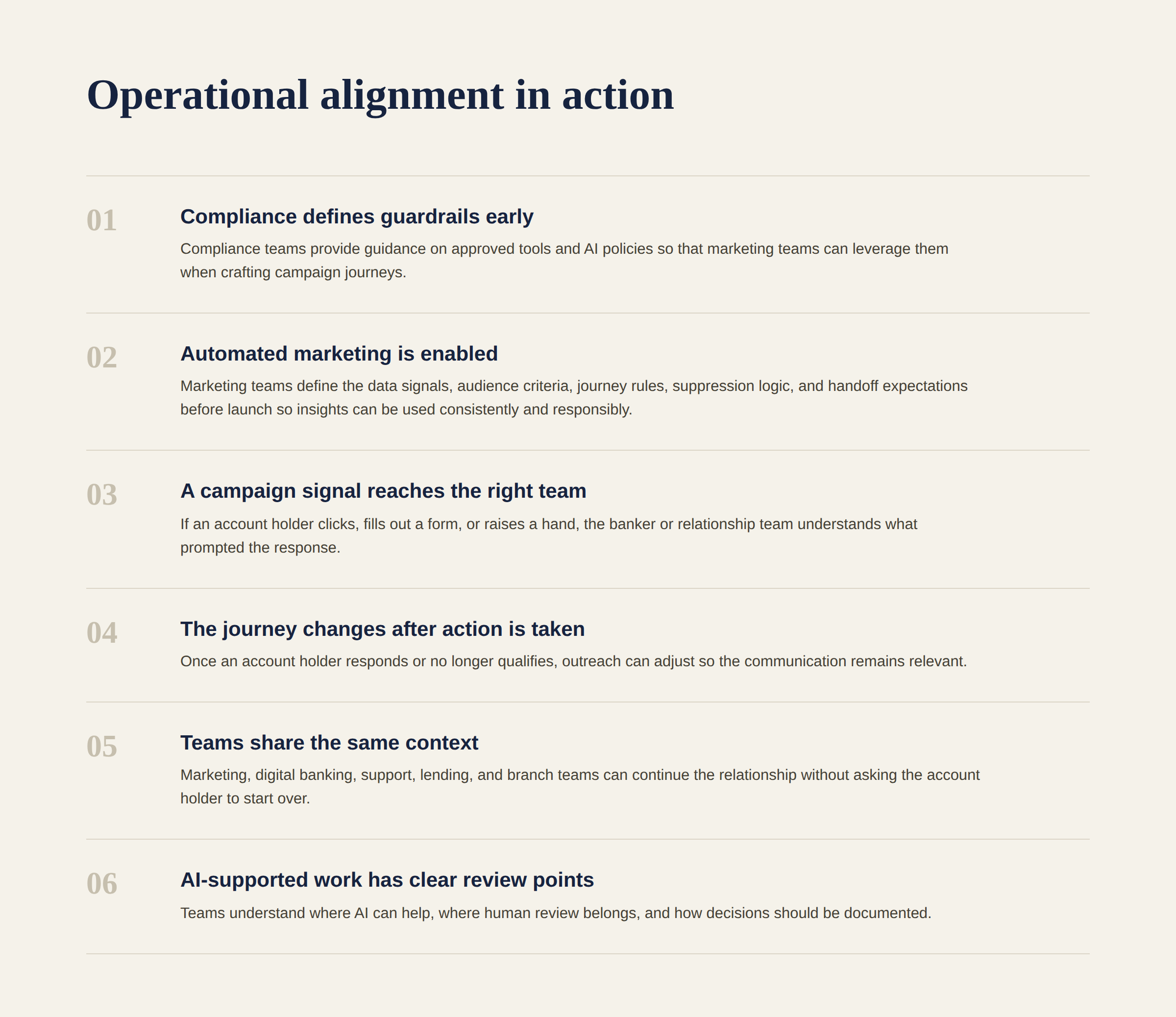
Responsible personalization does not end once a campaign is approved or a message is sent. The account holder’s experience depends on what happens across every team and system that touches the relationship.
From Colony Bank’s perspective, the campaign is only one moment. The handoff, follow-up, journey logic, and internal visibility across the organization determine whether the experience feels coordinated and the customer is supported across each touch point.
Read more about Colony Bank’s Digital Marketing Playbook
AI can help financial institution teams organize work, support content planning, analyze signals, and build more dynamic experiences. But the more personalized an experience becomes, the more important it is to define how decisions are made and reviewed.
Wright’s comments emphasize the need to create collaboration so that teams can move forward with AI responsibly.
To successfully leverage AI, financial institution marketers need to understand:
Those questions should not slow the work down. Once the foundation is set and guidelines are defined, marketing teams can act with confidence from the beginning and drive impactful results.
Wright’s closing recommendation in the episode was simple:
Colony Bank’s approach shows that responsible personalization depends on operational discipline. Teams need to understand the data, the audience, the message, the safeguards, and the handoff before the campaign goes live.
Personalized banking requires data, automation, and true collaboration behind the experience. When cross-functional departments work together, financial institutions are better positioned to use account holder insights in ways that feel timely, meaningful, and trustworthy.
Why should compliance be involved early in marketing strategy?
Compliance should be involved early so teams can understand risks, adjust campaign details, and move forward responsibly. Early collaboration helps marketing teams avoid rework and gives compliance teams the context they need to evaluate new uses of data, automation, or AI-powered tools.
What does operational alignment mean when marketing for financial institutions?
Operational alignment means the teams involved in the account holder experience understand the marketing campaign, the data behind it, the intended next step, and their role in the journey. It helps reduce fragmented experiences across marketing, digital banking, customer support, lending, and relationship teams.
How can financial institutions use AI responsibly in marketing?
Financial institutions can use AI responsibly by defining where AI supports the work, where human review is required, what data is being used, and how compliance should be involved. AI use must be backed by clear governance and should support judgment and execution through data-informed insights.
Why do handoffs matter in personalized banking?
Account holders experience the financial institution as one organization. Clear handoff helps the next interaction feel more informed and continuous. Keeping customer-facing teams informed of outreach efforts ensures each conversation can be approached with meaningful context.