
Blog, Strategies
March 26, 2026
Turning Chaos into Clarity: Translating Financial Services Data Analytics into Growth
Data analytics in banking unlocks opportunity for banks and credit unions Let’s go back 3,000 years ...
Business and commercial banking solutions are at a tipping point as financial institutions continue to navigate the change from traditional to digital in banking behaviors. Clients expect consumer‑grade experiences, real‑time visibility, and proactive guidance; meaning annual reviews and ad hoc calls don’t qualify anymore as relationship building. At the same time, fintechs and megabanks continue to raise the bar on speed and scale. Meanwhile, financial institution teams are feeling the pressure to prove impact.
Alkami’s research on The Top Trends Shaping Business & Commercial Banking in 2026 shows that AI‑powered relationship management is one of the top three trends commercial leaders expect to shape the year ahead. This is a clear signal that AI has moved from a buzzword to a practical differentiator for financial institutions that offer business and commercial banking solutions.
Below, we break down concrete AI use cases you can activate across business and commercial portfolios.
AI‑powered relationship management uses behavioral and transaction data to highlight opportunities that may have been missed. Traditional commercial banking has depended on trust, personal guidance, and expertise from relationship managers who operate based on what they know and remember about their clients. What’s changed is the volume and velocity of data around every client relationship: digital engagement, onboarding behaviors, payment patterns, risk signals, and transactions occurring outside of the financial institution.
AI shifts this from reactive to predictive:
Putting the modern approach of Anticipatory Banking into practice is defined as using AI and data to predict and meet needs before they’re voiced, across the account holder base including business and commercial relationships.
AI helps relationship managers focus on the right clients at the right time. By scoring accounts on churn risk, growth potential, and product fit, AI generates “hot lists” for proactive outreach so every conversation is anchored in timely, relevant insight instead of generic check‑ins.
Empowering operational teams so they can confidently support clients 1:1
Using cleansed, tagged behavioral data, predictive AI models can:
For regional and community institutions, this is how AI becomes a force multiplier; helping lean teams scale the kind of thoughtful, high‑touch engagement that has always been their differentiator.
Business payments are high value and high risk. By introducing AI as a component of a layered security strategy, financial institutions can leverage AI to augment tools like Check and ACH Positive Pay by learning each client’s normal patterns and highlighting anomalies in real time. This strategy can help institutions and clients stop fraud sooner, with fewer false positives and less manual review.
AI as a fraud co‑pilot inside commercial banking solutions
Paired with Positive Pay & ACH Reporting and other fraud tools, AI can:
AI transforms customer service by giving agents and virtual assistants instant context, suggested responses, and next best actions. This results in faster resolution times, more consistent answers, and support interactions that feel informed and proactive.
AI at the front line of commercial support
Within your service and support ecosystem, AI can:
AI turns raw transaction and engagement data into actionable opportunity segments to include:. :small to midsize businesses (SMBs) that look like your best commercial clients, businesses under‑utilizing treasury tools, or accounts sending payments to competitors. Teams can then design targeted campaigns and relationship management playbooks around real behavior.
Automated marketing that answers the question: how can we achieve our deposit goals?
With AI‑driven data insights, institutions can:
AI isn’t simply saying “who fits this product.” It’s saying “who is most likely to say yes right now based on their journey and behavior.” Through integrations between your Data & Marketing Solution and business banking platform, your institution can engage with target audiences and turn their data into an always‑on opportunity engine.
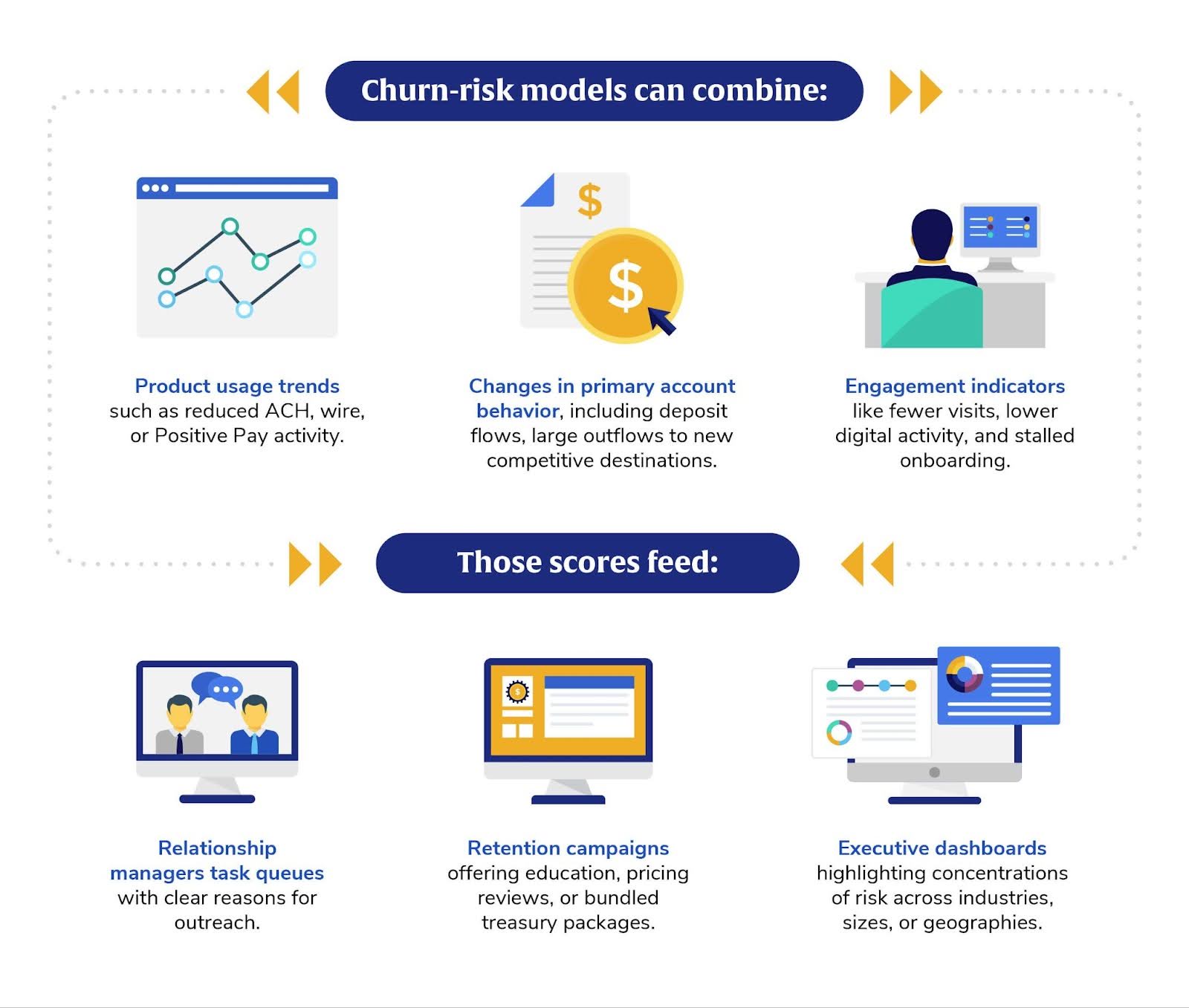
Churn rarely happens overnight. By using AI, your institution can spot subtle shifts such as declining balances, reduced login activity, fewer treasury transactions, or new transfers to competing institutions that may precede attrition. Teams can then prioritize retention strategies before high‑value relationships walk out the door.
From surprise attrition to early intervention
By revealing patterns in inflows, outflows, and concentration risk, AI also gives treasury teams a stronger starting point for conversations around efficiency with the executive leaders — shifting check-ins from backward-looking reporting to forward-looking cash and liquidity planning.
AI only creates value when it’s been informed by clean, actionable data. If it sits in silos, leaders won’t see the return that will have a significant impact on revenue growth. If onboarding data, transaction data, and digital banking behaviors all live in separate places, cross functional teams will always be reacting late.
The Alkami Digital Sales & Service Platform connects those moments so you can onboard, engage, and grow relationships from a unified experience.
By closing the loop between data, AI models, and commercial banking solutions, financial institutions can move from reactive servicing to anticipatory, AI‑assisted relationship management at a pace that matches 2026’s competitive market.
1. Why is AI-powered relationship management a top trend in commercial banking?
In Alkami’s research on 2026 commercial banking trends, digital banking decision‑makers placed AI‑powered relationship management among the top three trends expected to have the greatest impact on commercial banking. It reflects a shift toward proactive, insight‑led engagement that can scale without adding headcount.
2. How is AI in commercial banking different from traditional analytics?
Traditional analytics explain what happened after the fact. AI — especially predictive models — estimates what’s likely to happen next, such as which clients may churn, which are ready for new services, and which behaviors signal risk.
3. Do regional and community institutions need a large data science team to use AI?
Not if they leverage a platform that packages data cleansing, tagging, and modeling into ready‑to‑use capabilities. With solutions like Alkami’s Data & Marketing Solution, financial institutions can activate AI‑powered business and commercial use cases — churn prediction, next‑best‑product, fraud insights — while internal teams focus on strategy, governance, and execution.
4. How can banks and credit unions get started with AI in business and commercial banking?
Once institutional governance and framework are established, the most successful programs start with three steps:
From there, you can expand to additional segments, products, and channels as confidence and results grow.
5. How does AI support, rather than replace, relationship managers?
AI is a co‑pilot. It surfaces which businesses to prioritize and why, but humans still lead the conversations, apply judgment, and build trust. Institutions that treat AI as connective tissue across data and channels, not a standalone tool, see the greatest impact on relationship depth and growth.